Short Questions of Economics
Dr. Tanmoy Mukherji
Advocate
Short Questions of Economics-
Tanmoy Mukherji
Advocate
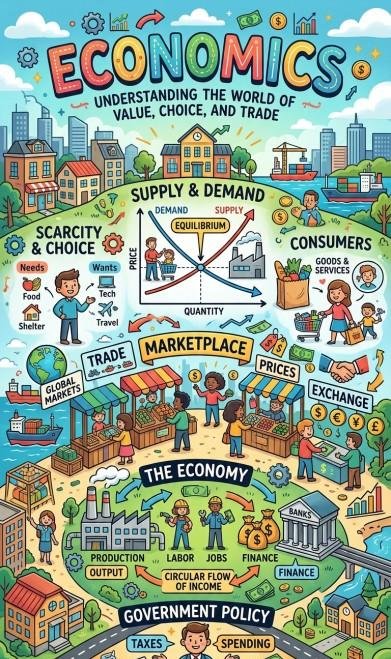
1.What is Economics?
Ans. Economics is the study of production, distribution and goods and services consumption.
2.What is scarcity?
Ans. Scarcity means limited resources compared to unlimited human wants.
3.What is opportunity cost?
Ans. Opportunity cost is the value of the next best alternative sacrificed.
4.Define demand.
Ans. Demand means the quantity consumers are willing and able to buy at a given price.
5.Define supply.
Ans. Supply refers to the quantity producers are willing to sell at a given price.
6.What is equilibrium price?
Ans. It is the price where demand equals supply.
7.What is elasticity of demand?
Ans. Elasticity measures responsiveness of demand to price change.
8.What is utility?
Ans. Utility means satisfaction derived from consumption.
9.Define marginal utility.
Ans. Marginal utility is additional satisfaction from consuming one more unit.
10.What is production?
Ans. Production is the creation of utility through goods and services.
11.What are factors of production?
Ans. Land, Labour, Capital and Entrepreneurship.
12.Define land in economics.
Ans. Land includes all natural resources used in production.
13.What is labour?
Ans. Labour means human physical and mental effort in production.
14.What is capital?
Ans. Capital refers to man-made resources used for production.
15.Define entrepreneur.
Ans. An entrepreneur organizes production and bears risks.
16.What is fixed capital?
Ans. Fixed capital includes machinery and buildings used repeatedly.
17.What is working capital?
Ans. Working capital includes raw materials and cash used in.
18.What is multiple cropping?
Ans. Growing more than one crop on production using HYV seeds and modern methods.
19.What are HYV seeds?
Ans. High Yielding Variety seeds that increase crop production.
20.What are HYV seeds?
Ans. High Yielding Variety seeds that increase crop production.
21. What is GDP?
Ans. GDP= C+I+G+(X-M)
GDP is the total value of final goods and services produced within a country.
22.Define GNP.
Ans. Gross National Product includes GDP plus net income from abroad.
23.What is NNP?
Ans. Net National Product = GNP - Depreciation.
24.Define inflation.
Ans. Inflation means a continuous rise in general price level.
25.What is deflation?
Ans. Deflation is a continuous fall in general price level.
26.Define stagflation.
Ans. Stagflation means inflation with unemployment and slow growth.
27.What is fiscal policy?
Ans. Fiscal policy relates to government taxation and expenditure.
28.What is monetary policy?
Ans. Monetary policy controls money supply and credit.
29.What is repo rate?
Ans. Repo rate is the rate at which RBI lends money to commercial banks.
30.What is reverse repo rate?
Ans. It is the rate at which RBI borrows from banks.
31.What is CRR?
Ans. Cash Reserve Ratio is the percentage banks keep with RBI.
32.What is national income?
Ans. National income is the total income earned by a nation in one year.
33.What is SLR?
Ans. Statutory Liquidity Ratio is the reserve banks maintain in liquid assets.
34.Define banking.
Ans. Banking means accepting deposits and giving loans.
35.What is credit?
Ans. Credit means borrowing money with promise of repayment.
36.Define collateral.
Ans. Collateral is an asset pledged against loans.
37.What is money?
Ans. Money is anything generally accepted as a medium of exchange.
38.Define barter system.
Ans. Exchange of goods for goods without money.
39.What is double coincidence of wants?
Ans. When two persons mutually need each other's goods.
40.What is modern currency?
Ans. Currency issued and authorized by the government.
41.What is poverty?
Ans. Poverty means inability to meet basic needs.
42.Define poverty line.
Ans. Minimum income required to meet basic necessities.
43.What is unemployment?
Ans. A condition where people willing to work cannot find jobs.
44.Define disguised unemployment.
Ans. More workers employed than actually required.
45.What is seasonal unemployment?
Ans. Unemployment during certain seasons of the year.
46.What is educated unemployment?
Ans. Educated persons unable to find suitable jobs.
47.Define human capital.
Ans. Human capital means education and skills of people.
48.What is literacy rate?
Ans. Percentage of literate people in a population.
49.What is infant mortality rate?
Ans. Number of infant deaths per thousand live births.
50.What is life expectancy?
Ans. Average expected lifespan of a person.
51.What is sustainable development?
Ans. Development without harming future generations.
52.Define globalization.
Ans. Increasing integration of economies worldwide.
53.What is liberalization?
Ans. Removal of government restrictions on economic activities.
54.Define privatization.
Ans. Transfer of public enterprises to private ownership.
55.What is WTO?
Ans. WTO (World Trade Organization) regulates international trade.
56.What is import?
Ans. Purchase of goods from foreign countries.
57.Define export.
Ans. Sale of goods to foreign countries.
58.What is balance of trade?
Ans. Difference between exports and imports.
59.What is balance of payments?
Ans. Record of all international transactions of a country.
60.What is foreign exchange?
Ans. Currency used in international trade.
61. What is public finance?
Ans. Study of government income and expenditure.
62. Define taxation.
Ans. Compulsory payment imposed by government.
63. What is direct tax?
Ans. Tax paid directly by individuals to government.
64. Define indirect tax.
Ans. Tax imposed on goods and services.
65. What is GST?
Ans. Goods and Services Tax imposed on supply of goods and services.
66. What is budget?
Ans. Annual financial statement of government income and expenditure.
67. Define fiscal deficit.
Ans. Excess of government expenditure over revenue.
68. What is revenue deficit?
Ans. Excess of revenue expenditure over revenue receipts.
69. Define public expenditure.
Ans. Government spending on public welfare and development.
70. What is public revenue?
Ans. Income earned by government from taxes and other sources.
71. What is primary sector?
Ans. Sector related to agriculture and extraction activities.
72. Define secondary sector.
Ans. Sector involved in manufacturing and industry.
73. What is tertiary sector?
Ans. Service sector of the economy.
74. Define organized sector.
Ans. Sector registered with government and regulated by laws.
75. What is unorganized sector?
Ans. Sector not regulated by government properly.
76. Define public sector.
Ans. Sector owned and managed by government.
77. What is private sector?
Ans. Sector owned and managed by private individuals.
78. Define infrastructure.
Ans. Basic facilities needed for economic development.
79. What is industrialization?
Ans. Growth of industries in an economy.
80. Define rural development.
Ans. Improvement of living conditions in rural areas.
81. What is food security?
Ans. Availability and accessibility of food to all people.
82. Define buffer stock.
Ans. Reserve stock of food grains maintained by government.
83. What is MSP?
Ans. Minimum Support Price given to farmers.
84. Define PDS.
Ans. Public Distribution System distributes food grains at subsidized rates.
85. What is FCI?
Ans. FCI (Food Corporation of India) procures and stores food grains.
86. Define famine.
Ans. Extreme scarcity of food causing starvation.
87. What is malnutrition?
Ans. Lack of proper nutrition.
88. Define hunger.
Ans. Condition caused by insufficient food intake.
89. What is food affordability?
Ans. Ability of people to purchase food.
90. Define food accessibility.
Ans. Availability of food to people.
91. What is market economy?
Ans. Economy where decisions are made through market forces.
92. Define mixed economy.
Ans. Economy with both private and public sectors.
93. What is economic planning?
Ans. Government planning for economic development.
94. Define Five Year Plan.
Ans. Government plan for development over five years.
95. What is economic reform?
Ans. Policy changes to improve economy.
96. Define disinvestment.
Ans. Selling government shares in public enterprises.
97. What is per capita income?
Ans. Average income per person.
98. Human Development Index.
Ans. Index measuring health, education and income.
99. What is economic growth?
Ans. Increase in national output over time.
100. Define economic development.
Ans. Economic growth with improvement in living standards.

we believe in a holistic approach to legal education building not just lawyers, but socially conscious leaders of tomorrow.
