RAJIV GANDHI ASSASSINATION CASE (STATE (CBI/SIT) v. NALINI & OTHERS, 1999) A LANDMARK CASE ON CRIMINAL CONSPIRACY AND TERRORISM-
Dr. Tanmoy Mukherji
Advocate
RAJIV GANDHI ASSASSINATION CASE
(STATE (CBI/SIT) v. NALINI & OTHERS, 1999)
A LANDMARK CASE ON CRIMINAL CONSPIRACY AND TERRORISM-
Tanmoy Mukherji
Advocate
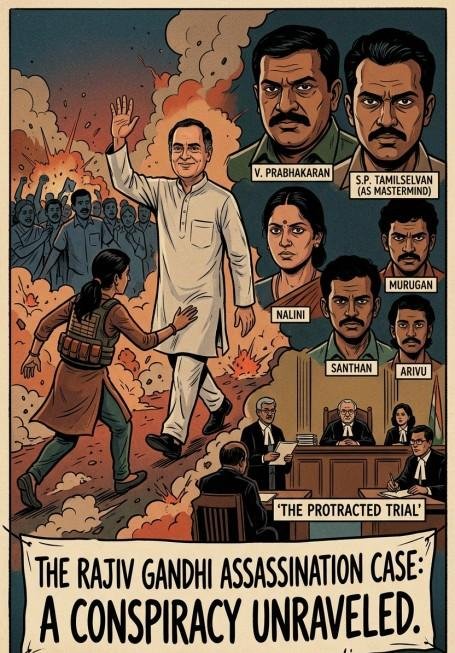
1. Introduction-
→The assassination of former Prime Minister Rajiv Gandhi is one of the most significant criminal conspiracy and terrorism cases in Indian legal history.
→It established important principles on conspiracy, circumstantial evidence, terrorist intent and collective liability.
→This case shook the nation and changed India's approach towards terrorism.
2. Factual Matrix-
Date: 21 May 1991
Time: Around 10:15 PM
Place: Sriperumbudur, Tamil Nadu
Event: Suicide bombing during election rally
Method: Human bomb (Dhanu) detonated explosives
Victim: Shri Rajiv Gandhi
Organization: LTTE (Liberation Tigers of Tamil Eelam)
3. Why Assassination?
→India sent IPKF (Indian Peace Keeping Force) to Sri Lanka (1987).
→IPKF was against LTTE's activities.
→Rajiv Gandhi was held responsible for their sufferings and loss.
MOTIVE: Revenge against Rajiv Gandhi for IPKF actions in Sri Lanka.
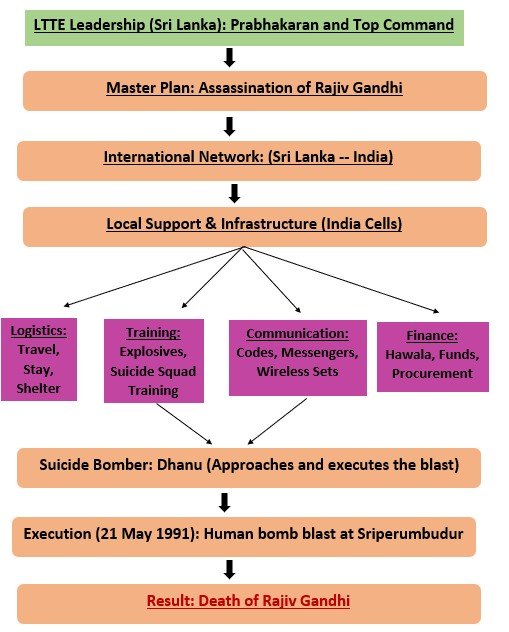
4. Conspiracy Structure (Master Diagram)-
5. Investigation at a Glance-
Investigating Agency: CBI - SIT
Arrests: 100+ persons
Charge Sheet: 11,000+ pages
Witnesses Examined: 250+
Documents Seized: 5,000+
Recovery: Explosives, Cyanide capsules, Wireless sets, Photos, Videos, Documents, Diary, SIM cards
6. Legal Provisions Involved-
IPC (Now BNS Equivalent)
→Sec. 120B IPC – Criminal Conspiracy (Sec. 61 BNS)
→Sec. 302 IPC – Murder (Sec. 103 BNS)
→Sec. 307 IPC – Attempt to Murder (Sec. 109 BNS)
→Sec. 109 IPC – Abetment (Sec. 111 BNS)
→Sec. 34 IPC – Common Intention (Sec. 3(5) BNS)
Special Law
TADA – Terrorist and Disruptive Activities (Prevention) Act
7. Core Legal Issues-
→Can conspiracy be proved without direct evidence?
→Whether the act qualifies as a "terrorist act" under TADA?
→What is the scope of vicarious liability of co-conspirators?
→Whether circumstantial evidence can form the sole basis of conviction?
8. Supreme Court Judgment (1999)-
→Trial Court awarded death penalty to 26 accused.
→Supreme Court judgment delivered on 11 May 1999.
→Conviction confirmed for 4 accused.
→Death sentences commuted to life imprisonment.
→Many accused acquitted due to lack of evidence.
→Convicted (4 Main Accused): Nalini, Murugan, Santhan, Perarivalan.
9. Important Legal Principles Laid Down-
→Conspiracy can be inferred from conduct. No written agreement is necessary.
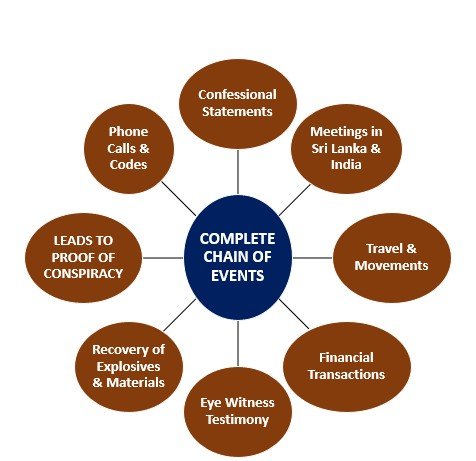
→Circumstantial evidence is sufficient. Complete chain of circumstances can prove guilt.
→Every conspirator is liable for acts of others. (Doctrine of constructive liability)
→Terrorist act requires "terror intent". Not every act of violence automatically attracts TADA.
→Motive is not essential, but relevant. Presence of motive strengthens prosecution.
→Participation, not proximity. Active role or intentional assistance establishes guilt.
10. Circumstantial Evidence Chain-
11. Role of Key Accused-
|
Accused |
Role
|
|
Nalini |
Local support, provided shelter, assisted in logistics.
|
|
Murugan |
Core conspirator, coordinated local operations.
|
|
Santhan |
Logistics, arranged vehicles, travel and stay.
|
|
Perarivalan |
Technical support, provided electronic devices, wireless sets, batteries.
|
|
Dhanu |
Suicide bomber who executed the attack.
|
12. Events-
→Motive (Revenge against India)
→ Planning (Secret agreement by LTTE)
→ Preparation (Training, Logistics, Funding)
→ Execution (21 May 1991 - Suicide Blast)
→ Investigation (CBI - SIT)
→ Trial (TADA Court)
→ Supreme Court Judgment (1999)
→ Sentence → Commutation → Release (2022)
13. Conspiracy vs Abetment-
|
Conspiracy |
Abetment |
|
Agreement between two or more persons.
|
Instigation, conspiracy or intentional aid.
|
|
Essence is the agreement.
|
Requires act of abetment.
|
|
Offence is complete even before the main act (in serious cases).
|
The main offence must be committed.
|
|
Liability of all for the act of one.
|
Liability is individual.
|
|
Usually secret and planned in advance.
|
May be open or by conduct.
|
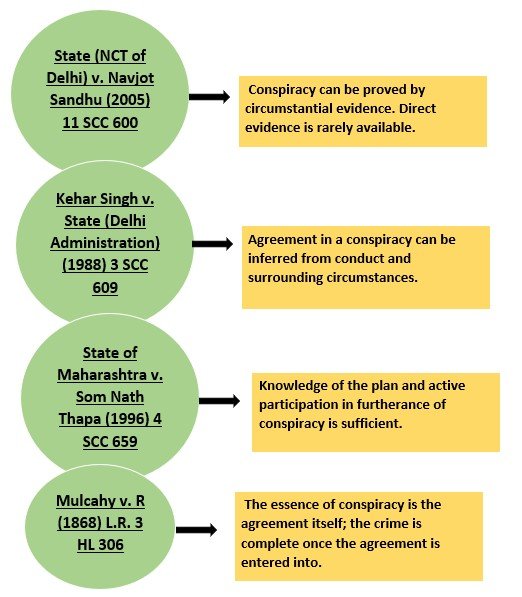
14. Important Case Laws (Related)-
15. Later Developments-
→Death sentences of all 4 convicts were commuted to life imprisonment.
→All convicts released on bail and later permanently released by Supreme Court on 18 May 2022.
16.Conclusion-
The Rajiv Gandhi assassination case is a classic example of criminal conspiracy and terrorism. It reaffirmed that:
→Agreement can be inferred from circumstances.
→Circumstantial evidence can be sufficient.
→Collective liability applies in conspiracy.
→Terror intent must be established for TADA.
→A judgment that shaped Indian criminal jurisprudence.
17. Golden Line for Exam
"Criminal conspiracy is hatched in secrecy; hence it is proved through circumstances, not direct evidence."

we believe in a holistic approach to legal education building not just lawyers, but socially conscious leaders of tomorrow.
