PUBLIC POLICY (SHORT NOTES)-
Dr. Tanmoy Mukherji
Advocate
PUBLIC POLICY (SHORT NOTES)-
Tanmoy Mukherji
Advocate
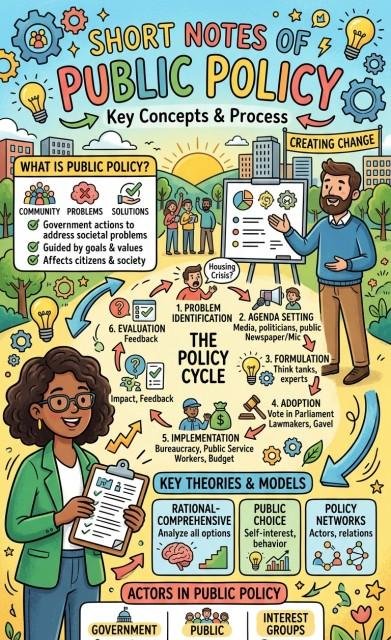
MEANING-
Public policy refers to the principles, plans, and courses of action adopted by the government to address public issues and achieve desired goals for the welfare of society.
KEY FEATURES-
→Goal oriented
→Government initiated
→Public welfare focused
→Based on values and priorities
→Dynamic and responsive
→Enforced by law and authority
TYPES OF PUBLIC POLICY-
→Economic Policy
→Social Policy
→Political Policy
→Environmental Policy
→Educational Policy
→Health Policy
POLICY MAKING PROCESS-
→Problem Identification
→ Policy Formulation
→ Decision Making
→ Implementation
→ Evaluation
IMPORTANCE-
→Addresses public problems
→Promotes welfare and equity
→Ensures orderly governance
→Guides decision making
→Promotes development
→Strengthens accountability
E GOVERNANCE-
E Governance refers to the use of information and communication technology (ICT) by the government to deliver services to citizens, improve efficiency, transparency, and promote participation in the governance process.
OBJECTIVES-
→Provide better citizen services
→Improve transparency and accountability
→Increase efficiency and effectiveness
→Reduce corruption
→Promote participatory governance
→Bridge the digital divide
KEY COMPONENTS-
Online Services: Delivery of government services online
Information Management: Efficient management and sharing of information
Process Re-engineering: Simplifying and automating government processes
ICT Infrastructure: Strong digital infrastructure and connectivity
Capacity Building: Training and skill development of government employees
BENEFITS-
→Easy access to services
→Time and cost saving
→Greater transparency
→Improved accountability
→Efficient resource management
→Enhanced citizen satisfaction
EXAMPLES IN INDIA-
Digital India: Transforming India into a digitally empowered society
UMANG App: Unified Mobile Application for New-Age Governance
DigiLocker: Secure digital storage of documents
e-NAM: Electronic National Agriculture Market
GSTN: Goods and Services Tax Network
GOOD GOVERNANCE-
Good governance refers to the exercise of power in a manner that is efficient, transparent, accountable, inclusive and responsive to the needs of the people.
PRINCIPLES OF GOOD GOVERNANCE-
Participation: Involvement of all stakeholders in the decision-making process
Rule of Law: Fair and equal application of laws
Transparency: Open and accessible information
Accountability: Answerability for actions and decisions
Effectiveness: Achieving desired results and outcomes
Efficiency: Optimal use of resources
Equity and Inclusiveness: Fairness and equal opportunities for all
Responsiveness: Timely and appropriate response to needs
Sustainability: Ensuring long-term development and environmental protection
IMPORTANCE-
→Builds trust in government
→Promotes social justice and equality
→Reduces corruption
→Improves quality of public services
→Supports sustainable development
→Enhances national and global reputation
INDICATORS-
→Low corruption
→Political stability
→Government effectiveness
→Regulatory quality
→Rule of law
→Control of corruption
→Voice and accountability
"Good governance is the cornerstone of a just, prosperous and democratic society."
NITI AAYOG-
NITI Aayog (National Institution for Transforming India) is the think tank of the Government of India, established on 1st January 2015. It replaced the Planning Commission.
OBJECTIVES-
→Foster cooperative federalism
→Promote competitive federalism
→Encourage participative approach
→Formulate long-term strategies and policies
→Support sustainable development and inclusive growth
FUNCTIONS-
→Policy formulation and advice
→Monitoring and evaluation
→Capacity building
→Knowledge and innovation hub
→Promoting best practices
KEY FEATURES-
→Think tank role
→Non-constitutional body
→Inclusive and participative approach
→Evidence-based policy making
→Focus on innovation and technology
→Collaborates with states and various stakeholders
IMPORTANT INITIATIVES-
→Sustainable Development Goals (SDGs) India
→Aspirational Districts Programme
→Atal Innovation Mission
→Transforming India Awards
→Global Innovation Index

we believe in a holistic approach to legal education building not just lawyers, but socially conscious leaders of tomorrow.
