Plato’s Theory of Justice
Dr. Tanmoy Mukherji
Advocate
Plato’s Theory of Justice
Tanmoy Mukherji
Advocate
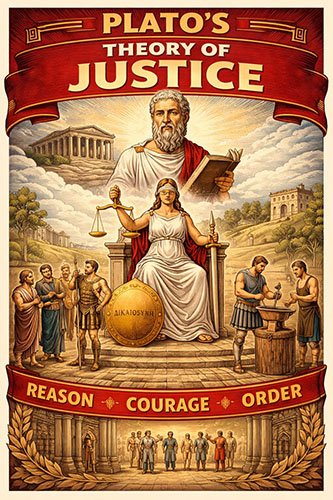
Plato’s theory of justice is elaborately discussed in his celebrated dialogue The Republic, particularly in Books I–IV. Plato treats justice not merely as a legal or political principle but as a comprehensive moral ideal governing both the individual soul and the state. For him, justice is the foundation of a good life and a well-ordered society.
Background: Search for the Meaning of Justice-
In The Republic, Plato begins by critically examining popular definitions of justice proposed by thinkers such as Cephalus, Polemarchus, and Thrasymachus:
Cephalus: Justice is telling the truth and paying debts.
Polemarchus: Justice is helping friends and harming enemies.
Thrasymachus: Justice is the interest of the stronger.
Plato rejects all these views as incomplete or morally flawed and undertakes a systematic inquiry to discover the true nature of justice.
Justice as Harmony-
Plato defines justice as a condition of harmony and order, where every part performs its proper function.
Justice means doing one’s own work and not interfering with the work of others.
Justice is therefore a principle of functional specialization, ensuring balance within both the individual and the state.
Justice in the Individual (Psychological Aspect)-
Plato explains justice in the individual by analyzing the human soul, which consists of three elements:
Rational Part (Reason)-
Seeks truth and knowledge
Governs through wisdom
Should rule the soul
Spirited Part (Spirit)-
Source of courage, honour, ambition
Supports reason
Controls emotions like anger
Appetitive Part (Appetite)-
Desires food, wealth, pleasure
Most irrational element
Must be controlled
Justice in the Individual Exists When:
Reason rules,
Spirit supports reason,
Appetite obeys both.
Justice is thus inner moral discipline, not external obedience.
Justice in the State (Political Aspect)
Plato establishes a close analogy between the individual and the state. Just as the soul has three parts, the state has three classes:
Ruling Class – Philosopher Kings
Guided by reason and wisdom
Responsible for governance
Possess knowledge of the Idea of Good
Auxiliary Class – Soldiers
Embody courage
Defend the state
Maintain internal and external security
Producing Class – Artisans, Farmers, Traders
Provide material needs
Governed by desire and self-restraint
Justice in the State Exists When:
Each class performs its assigned function,
No class interferes in another’s role,
Rulers rule, soldiers protect, producers produce.
Four Cardinal Virtues-
Plato identifies four cardinal virtues in the ideal state:
→Wisdom – in rulers
→Courage – in soldiers
→Temperance – in all classes
→Justice – harmony among all
Justice is the coordinating virtue that ensures the proper functioning of the other three.
Philosopher-King and Justice-
Plato argues that justice can exist only when the state is ruled by philosophers:
“Until philosophers are kings or kings become philosophers, there will be no end to the troubles of states.”
Philosopher-kings:
→Love truth
→Possess moral insight
→Govern selflessly
→Understand the Idea of Good, the ultimate source of justice
Education and Justice-
Plato emphasizes education as the foundation of justice:
→Moral education for character building
→Intellectual training for rulers
→Physical training for soldiers
→Music and gymnastics to balance soul and body
→Proper education ensures that individuals naturally perform their designated roles.
Communism of Property and Family-
To preserve justice among rulers and soldiers, Plato proposes:
→Common property
→No private families
→Equal education for men and women
→This prevents greed, nepotism, and corruption, though it remains highly controversial.
Ethical Nature of Plato’s Justice-
Plato’s justice is:
→Moral rather than legal
→Based on virtue, not rights
→Concerned with inner righteousness
→Focused on social harmony rather than equality
Criticism of Plato’s Theory-
Plato’s theory has faced several criticisms:
→Class rigidity – denies social mobility
→Suppression of individual freedom
→Utopian and impractical
→Neglect of individual rights
→Over-emphasis on state control
→Aristotle criticized Plato for ignoring human emotions and practical realities.
Importance and Influence-
Despite criticism, Plato’s theory:
→Laid the foundation of political philosophy
→Influenced ideas of justice, governance, and morality
→Shaped later thinkers like Aristotle, Augustine, and modern idealists
Conclusion
Plato’s theory of justice views justice as moral harmony, both within the individual and the state. It emphasizes duty, virtue, and order over rights and equality. Though idealistic, it remains one of the most profound and enduring theories of justice in Western philosophy.

we believe in a holistic approach to legal education building not just lawyers, but socially conscious leaders of tomorrow.
