Pigeonhole Theory (Salmond’s View)
Dr. Tanmoy Mukherji
Advocate
Pigeonhole Theory (Salmond’s View)-
Tanmoy Mukherji
Advocate
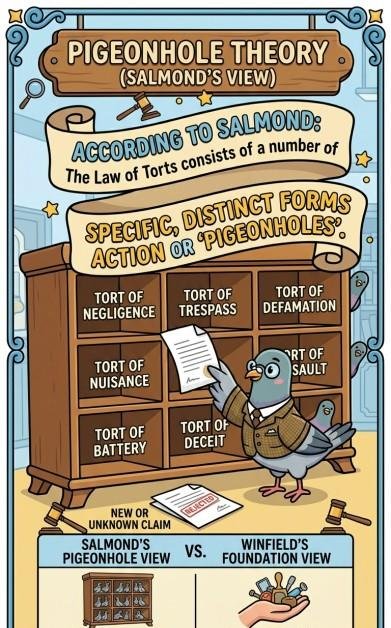
The Pigeonhole Theory comes from Salmond’s definition of tort in his Jurisprudence.
Salmond’s Definition:
“Just as the pigeonholes in a drawer are provided for the reception of pigeons, so also the law of torts consists of a number of specific heads of liability, outside which the liability does not exist. If a man’s wrong cannot be brought under any one of these heads, he has committed no tort.”
This is why it is called the Pigeonhole Theory.
1.Closed system →
The law of torts is not general. Only wrongs that fall into recognized categories of torts are actionable. No general principle of liability.
2.Fixed pigeonholes →
Each recognized tort is like a “pigeonhole”: Negligence Nuisance Defamation Trespass (to land, goods, person) Assault & Battery False imprisonment Deceit, etc.
3.No pigeonhole, no tort →
If an act is wrongful but does not fit into any known pigeonhole, it is not actionable in tort law (unless a new category is judicially recognized).
Contrast with Winfield’s View
Winfield’s General Principle Theory (opposite to Salmond):
Law of tort is based on a general principle that “all unjustifiable harm is a tort unless there is a legal justification.”
This means tort law is open and flexible → Courts can recognize new torts as society evolves.
Salmond’s Pigeonhole Theory:
Restrictive and rigid → Tort is limited to pre-defined pigeonholes. No general liability exists.
Judicial Approach
→English Courts historically leaned more towards Salmond’s Pigeonhole Theory, treating tort as specific wrongs only.
→But over time, courts began recognizing new wrongs (e.g., negligence evolved in Donoghue v. Stevenson (1932)), showing influence of Winfield’s open theory.
Examples-
1.If a person negligently drives and injures someone → fits into negligence pigeonhole → actionable.
2.If a person publishes false statement harming reputation → fits into defamation pigeonhole.
3.But if a person causes emotional distress in a way not recognized as defamation, nuisance, assault, etc., → under Salmond’s theory, no tort, since no pigeonhole exists.

we believe in a holistic approach to legal education building not just lawyers, but socially conscious leaders of tomorrow.
