LEGISLATIVE HISTORY AND EXTERNAL AIDS TO INTERPRETATION OF STATUTES-
Dr. Tanmoy Mukherji
Advocate
LEGISLATIVE HISTORY AND EXTERNAL AIDS TO INTERPRETATION OF STATUTES-
Tanmoy Mukherji
Advocate
INTRODUCTION-
When the words of a statute are ambiguous, obscure or incomplete, courts look beyond the statute and use external aids to discover the legislative intention and to interpret the statute effectively and justly.
OBJECT OF EXTERNAL AIDS-
→Discover legislative intention
→Remove ambiguity and uncertainty
→Understand social and historical context
→Clarify doubtful or technical expressions
→Promote justice and purposive interpretation
→Make the statute workable and effective
TYPES OF EXTERNAL AIDS-
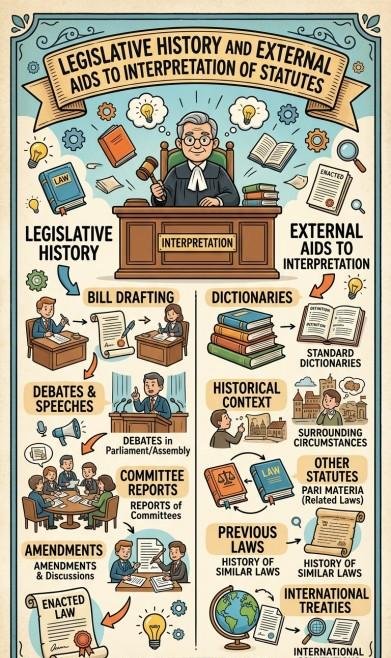
1.Legislative History (English, American & Indian Practices)
2.Historical Facts and Surrounding Circumstances
3.Later Social, Economic, Political, Scientific & Technological Developments
4.Contemporanea Expositio or Executive Construction
5.References to Statutes in Pari Materia
6.Use of Dictionaries
7.Use of Legal Texts
8.Use of International Treaties
9.Use of Foreign Decisions
1. LEGISLATIVE HISTORY (ENGLISH, AMERICAN & INDIAN PRACTICES)-
Meaning: Materials showing the origin, development, background and intention behind the legislation.
Includes:
→Bills and drafts,
→Parliamentary debates,
→Committee reports,
→Statement of Objects & Reasons,
→Amendments and historical records,
→Ministerial speeches.
ENGLISH PRACTICE:
Traditionally, English courts were reluctant to use Parliamentary Debates. Case: Davis v. Johnson (1979).
Change in Law: Pepper v. Hart (1993).
Now allowed when:
1. Statute is ambiguous,
2. Material is clear,
3. Statement by Minister/Promoter.
AMERICAN PRACTICE:
Extensive use of Congressional debates, committee reports and legislative records to determine legislative intent.
INDIAN PRACTICE:
Moderate approach. Courts may rely on Parliamentary Debates, Statement of Objects & Reasons, Committee Reports.
Case: K.P. Varghese v. ITO, AIR 1981 SC 1922.
Principle: Legislative history cannot override clear and unambiguous words of the statute.
2. HISTORICAL FACTS AND SURROUNDING CIRCUMSTANCES-
Meaning: Courts examine the historical facts, social, political and economic conditions existing at the time when the statute was enacted.
Object: To understand the social evil, defect or mischief which the law intended to remedy.
Examples:
Labour laws—industrial exploitation;
Land reform laws—zamindari system;
Constitutional provisions—colonial history.
Case: Bengal Immunity Co. v. State of Bihar, AIR 1955 SC 661.
Importance: Explains the legislative context and purpose, helps in purposive interpretation and suppresses the mischief.
3. LATER SOCIAL, ECONOMIC, POLITICAL, SCIENTIFIC & TECHNOLOGICAL DEVELOPMENTS-
Meaning: Courts consider the later developments in society, economy, politics, science and technology while interpreting statutes.
Principle: Law is a living and dynamic instrument and must adapt to changing times.
Important Cases:
→State v. N.M. Thomas, (1976) 2 SCC 310 — Dynamic interpretation.
→Vishaka v. State of Rajasthan, (1997) 6 SCC 241 — Considered international standards.
→Justice K.S. Puttaswamy v. UOI, (2017) 10 SCC 1 — Considered technological developments in privacy law.
Importance: Keeps the law up to date and ensures practical justice in modern society.
4. CONTEMPORANEA EXPOSITIO OR EXECUTIVE CONSTRUCTION-
Meaning: Interpretation placed by administrative authorities or executive agencies at or around the time when the statute was enacted.
Principle: Long standing executive interpretation has persuasive value and guiding role.
Object: Shows practical understanding and administrative application of the statute.
Case: Desh Bandhu Gupta v. Delhi Stock Exchange Association, AIR 1950 SC 248.
Limitation: Executive interpretation cannot prevail over clear and unambiguous language of the statute.
Importance: Reflects practical understanding, helps resolve ambiguity and shows how the law was understood in practice.
5. REFERENCES TO STATUTES IN PARI MATERIA-
Meaning: Statutes relating to the same subject matter or forming part of the same legal system are called statutes in pari materia.
Principle: Such statutes should be read together and harmoniously interpreted.
Object:
→Ensures consistency and uniformity,
→Harmonises related statutes,
→Clarifies meaning and removes ambiguity.
Examples: Different labour laws, tax laws, environment laws.
Case: State of Madras v. A.V. Fernandez, AIR 1957 SC 576.
Importance: Ensures consistency, avoids conflict and promotes harmonious interpretation.
6. USE OF DICTIONARIES-
Meaning: Courts use dictionaries to ascertain the ordinary, natural and grammatical meaning of words used in the statute.
Types:
→General dictionaries,
→Legal dictionaries,
→Technical dictionaries.
Principle: Dictionary meaning is not conclusive. Meaning depends on context and legislative intent.
Case: Brownsea Haven Properties v. Poole Corporation, (1958) 1 QB 929.
Importance: Helpful where words are undefined or have technical meaning.
7. USE OF LEGAL TEXTS-
Meaning: Courts refer to juristic writings, commentaries, textbooks and legal literature.
Examples: Maxwell on Interpretation, Craies on Statute Law, Salmond, Dicey, M.P. Jain etc.
Object: To understand legal principles, historical evolution and theoretical background.
Case: Kesavananda Bharati v. State of Kerala, (1973) 4 SCC 225.
Importance: Legal texts have persuasive value and help in proper understanding of law.
8. USE OF INTERNATIONAL TREATIES-
Meaning: Courts may use international conventions, treaties, declarations and other international instruments while interpreting statutes.
Principle: International law may be used to interpret municipal law if there is no inconsistency.
Important Cases:
→Vishaka v. State of Rajasthan, (1997) 6 SCC 241 (reliance on CEDAW Convention)
→Apparel Export Promotion Council v. A.K. Chopra, (1999) 1 SCC 759
Importance: Promotes human rights, harmonises global standards and supports India’s international obligations.
9. USE OF FOREIGN DECISIONS-
Meaning: Courts may refer to foreign judgments and comparative constitutional jurisprudence.
Object: To obtain guidance, comparative reasoning and advanced jurisprudence.
Important Cases:
→A.K. Gopalan v. State of Madras, AIR 1950 SC 27 (reliance on American decisions)
→Navtej Singh Johar v. UOI, (2018) 10 SCC 1 (reliance on foreign LGBTQ jurisprudence)
→Justice K.S. Puttaswamy v. UOI, (2017) 10 SCC 1 (reliance on foreign privacy cases)
Importance: Expands legal reasoning, promotes global jurisprudence and assists constitutional interpretation.
INTERNAL AIDS vs EXTERNAL AIDS-
|
Basis |
Internal Aids |
External Aids
|
|
Source |
Within the statute |
Outside the statute
|
|
Nature |
Primary aids |
Secondary aids
|
|
Examples |
Preamble, heading, marginal notes, proviso, punctuation, definition |
Legislative history, historical facts, dictionaries, treaties, foreign decisions
|
|
Purpose |
Clarify wording and structure |
Discover intention and remove ambiguity
|
|
Authority |
Direct and primary |
Indirect and persuasive
|
ADVANTAGES OF EXTERNAL AIDS-
→Clarifies ambiguity
→Discovers legislative intention
→Promotes justice and fairness
→Adapts law to changing society
→Supports purposive interpretation
→Prevents absurdity and hardship
CRITICISM OF EXTERNAL AIDS-
→Leads to judicial subjectivity
→Risk of judicial legislation
→Creates uncertainty
→Time-consuming process
→Excessive reliance may distort legislative intent
→Weakens textual certainty.
IMPORTANT CASE LAWS SUMMARY-
|
CASE LAWS |
SUMMARY |
|
Davis v. Johnson (1979) |
English restraint
|
|
Pepper v. Hart (1993) |
Liberal use in England
|
|
K.P. Varghese v. ITO (1981) |
Legislative history in India
|
|
Bengal Immunity Co. v. State of Bihar |
Historical background
|
|
Desh Bandhu Gupta |
Executive construction
|
|
State of Madras v. A.V. Fernandez |
Pari Materia
|
|
Brownsea Haven Case |
Dictionaries
|
|
Vishaka v. State of Rajasthan |
Treaties |
|
Navtej Singh Johar & Puttaswamy |
Foreign Decisions & Modern developments.
|

we believe in a holistic approach to legal education building not just lawyers, but socially conscious leaders of tomorrow.
