JUDICIARY AS A COMPONENT OF CRIMINAL JUSTICE SYSTEM-
TANMOY MUKHERJI INSTITUTE OF JURIDICAL SCIENCE
Dr. Tanmoy Mukherji
Advocate
JUDICIARY AS A COMPONENT OF CRIMINAL JUSTICE SYSTEM-
Tanmoy Mukherji
Advocate
Introduction-
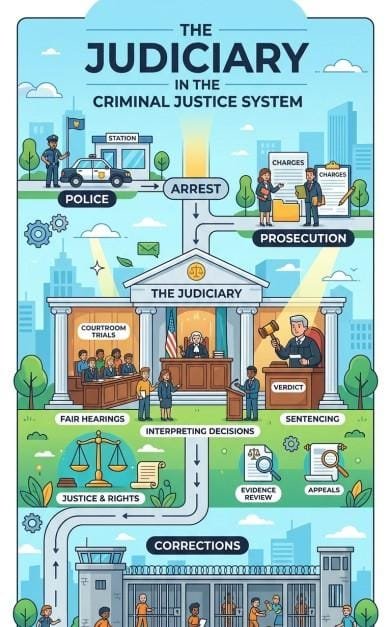
→The judiciary is a core and indispensable component of the criminal justice system.
→It adjudicates criminal disputes brought before it by the State against the accused.
→It ensures that criminal law is fairly and impartially applied in accordance with the Constitution, statutes and established principles of law.
→The judiciary acts as an independent and impartial decision-maker to determine guilt or innocence and to impose lawful punishment.
→It protects the rights of the accused, victims and society, and maintains the rule of law, public confidence and legitimacy of the criminal justice system.
→An independent and impartial judiciary is essential for a fair, just and humane criminal justice system.
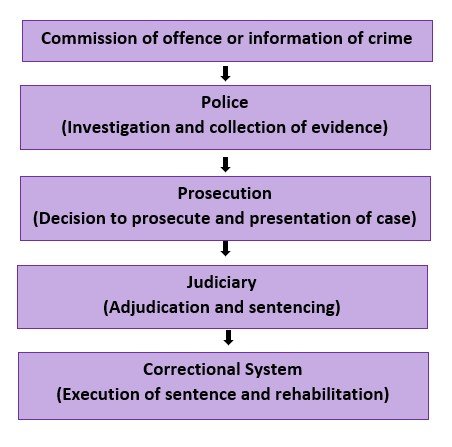
Position in Criminal Justice System-
Constitutional and Legal Basis-
Article 50 (Directive Principles) – Separation of judiciary from the executive.
Articles 124–147 – Supreme Court of India.
Articles 214–231 – High Courts.
Articles 233–237 – Subordinate Judiciary.
Article 21 – Protection of life and personal liberty (fair, just and reasonable criminal trial).
Article 39A – Equal justice and free legal aid.
CrPC, 1973 – Procedure for adjudication of criminal cases.
Indian Evidence Act, 1872 – Rules of evidence.
BNS, 2023 – Substantive criminal offences.
Judicial independence is part of the basic structure of the Constitution (Kesavananda Bharati v. State of Kerala, 1973).
Nature and Role-
→Adjudicates disputes between the State and the accused.
→Determines guilt or innocence on the basis of evidence and law.
→Ensures fair trial, due process and natural justice.
→Imposes lawful punishment as per statute.
→Protects fundamental and legal rights of the accused, victims and society.
→Interprets criminal statutes and develops judicial precedents.
→Acts as a check on executive excesses and illegal actions.
→Ensures accountability of investigating agencies and prosecution.
Objectives-
→To ensure a fair and impartial trial.
→To determine guilt or innocence in accordance with law.
→To protect the rights of the accused, victims and society.
→To impose just and proportionate punishment.
→To ensure application of criminal law without fear or favour.
→To maintain public confidence in the criminal justice system.
Functions of Judiciary-
→Interpretation of criminal laws.
→Adjudication of criminal cases.
→Evaluation of evidence and determination of facts.
→Ensuring fair trial and due process.
→Imposition of sentence.
→Granting bail.
→Supervision over investigation and prosecution (judicial scrutiny).
→Protection of fundamental and legal rights.
→Development of jurisprudence through judicial precedents.
→Ensuring accountability of state agencies.
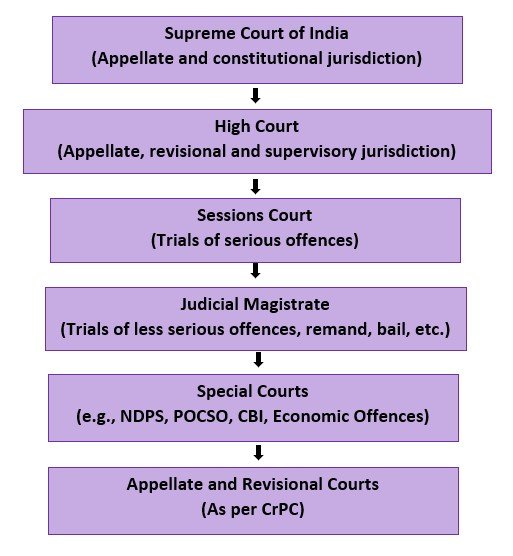
Hierarchy of Criminal Courts in India-
Judicial Safeguards for Accused and Victims-
→Presumption of innocence.
→Right to legal representation (Article 22 and Section 303 CrPC).
→Right to fair and speedy trial (Article 21).
→Right to cross-examine witnesses.
→Protection against self-incrimination (Article 20(3)).
→Humane and proportionate sentencing.
→Victim participation and protection (Section 372 CrPC, Victim Compensation Schemes).
→Use of in-camera trials, witness protection measures and special procedures for vulnerable victims (e.g., POCSO).
Judicial Oversight and Control-
→Scrutiny of legality of arrest, detention and investigation (Sections 167, 173 CrPC).
→Grant or denial of bail.
→Monitoring compliance with fundamental rights.
→Directions to investigating agencies (Supervisory jurisdiction under Articles 226 and 227).
→Ensuring fair and impartial prosecution.
→Review of confessions and inadmissible evidence (Sections 24–30, Indian Evidence Act).
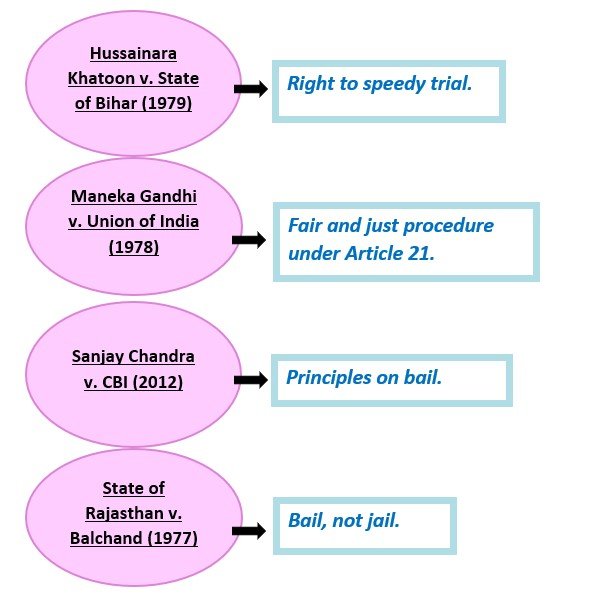
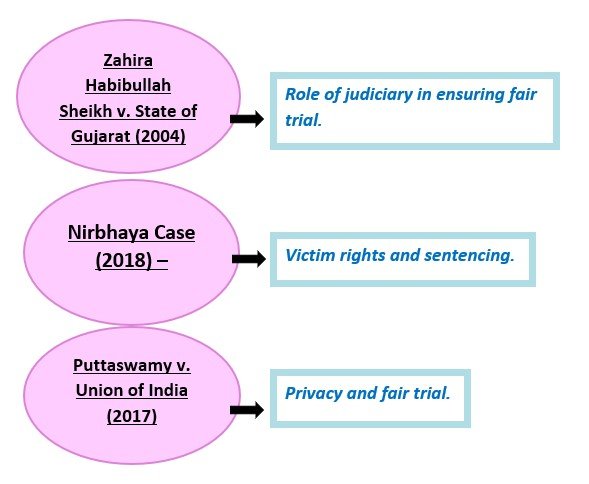
Landmark Judgments-
Challenges-
→Case backlog and delay in trials.
→Shortage of judges and infrastructure.
→Complexity of modern criminal offences (cybercrime, organised crime).
→Ensuring witness protection and victim participation.
→Balancing individual rights with societal security.
→Maintaining independence amidst external pressures.
→Need for specialisation and use of technology (e-courts, virtual hearings).
Importance in Criminal Justice System-
→Ensures impartial adjudication.
→Maintains the rule of law.
→Legitimises the criminal justice system.
→Protects rights and liberties of individuals.
→Promotes public confidence in justice delivery.
→Acts as a guardian against misuse of power.
→Contributes to crime control through fair and lawful sentencing.
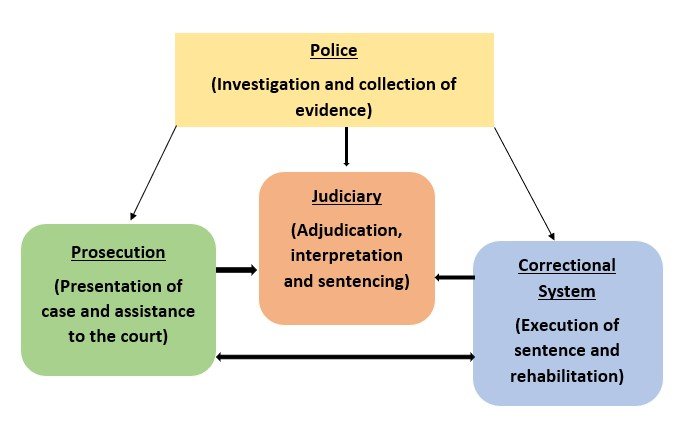
Inter-relationship with Other Components-
Conclusion-
The judiciary is a foundational component of the criminal justice system. By ensuring a fair, impartial and lawful determination of criminal cases, it protects the rights of the accused, victims and society, maintains the rule of law and strengthens public confidence in the justice system. An independent, efficient and rights-based judiciary is essential for a just, humane and effective criminal justice system.

we believe in a holistic approach to legal education building not just lawyers, but socially conscious leaders of tomorrow.
