INTERPRETATION OF STATUTES- 5 Marks Question/ Answers
TANMOY MUKHERJI INSTITUTE OF JURIDICAL SCIENCE
Dr. Tanmoy Mukherji
Advocate
INTERPRETATION OF STATUTES- 5 Marks Question/ Answers-
Tanmoy Mukherji
Advocate
1) SENTENTIA LEGIS-
Meaning: "Sententia legis" means the spirit or intention of the law. The true intention of the legislature is the soul of interpretation.
Principle: Courts should interpret statutes according to legislative intention and purpose rather than merely literal words.
Importance:
→Helps discover legislative intention
→Prevents injustice
→Promotes purposive interpretation
→Removes ambiguity
→Makes law effective.
Case: Heydon's Case (1584)
2) EX VISCERIBUS ACTUS-
Meaning: "Ex visceribus actus" means a statute must be read as a whole. Every provision should be interpreted harmoniously and in context of the entire statute.
Principle: No section should be interpreted in isolation.
Importance:
→Maintains consistency
→Avoids contradiction
→Promotes harmonious construction
→Gives complete meaning.
Case: Reserve Bank of India v. Peerless General Finance Co.
3) UT RES MAGIS VALEAT QUAM PEREAT-
Meaning: Interpretation should make the statute effective rather than void.
Principle: If two interpretations are possible, the court adopts that interpretation which upholds the validity of the statute.
Importance:
→Saves legislation
→Prevents invalidity
→Promotes effectiveness
→Avoids absurdity.
Case: Tinsukhia Electric Supply Co. v. State of Assam.
4) REDDENDO SINGULA SINGULIS-
Meaning: Words should be referred to their respective subjects.
Principle: Each expression must be distributed according to its proper grammatical relation.
Example: "Men and women shall respectively inherit and transfer property."
|
Interpretation
|
Importance:
→Removes ambiguity
→Ensures grammatical interpretation
→Clarifies meaning
Case: Koteshwar Vittal Kamath v. K. Rangappa Baliga.
5) DIFFERENCE BETWEEN INTERPRETATION AND CONSTRUCTION-
|
Basis |
Interpretation |
Construction
|
|
Meaning |
Discovering the true meaning |
Drawing conclusions
|
|
Nature |
Literal understanding |
Legal reasoning
|
|
Objective |
Explain words |
Determine legal effect
|
|
Scope |
Narrow |
Wider
|
|
Function |
Clarifies the text |
Applies law practically
|
Importance: Interpretation explains the meaning of words while construction determines their legal consequences.
6) INTERPRETATION OF PENAL STATUTES-
Meaning: Penal statutes define offences and prescribe punishment.
Rule: Penal statutes are interpreted strictly.
Principle: No person can be punished unless his act is clearly covered by law.
Key Points:
→Strict interpretation
→Benefit of doubt to accused
→No punishment by implication
→Protection of individual liberty.
Case: Tolaram Relumal v. State of Bombay
Conclusion: Strict interpretation prevents arbitrary punishment and protects liberty.
7) INTERPRETATION OF REMEDIAL STATUTES-
Meaning: Remedial statutes remove defects, provide remedies and protect rights.
Rule: Remedial statutes are interpreted liberally.
Principle: To advance remedy and suppress mischief.
Examples: Labour welfare laws, Consumer protection laws.
Case: Workmen of American Express International Banking Corp. v. Management
Conclusion: Liberal interpretation promotes social justice and welfare objectives.
8) INTERPRETATION OF FISCAL STATUTES-
Meaning: Fiscal statutes relate to taxation, revenue and duties.
Rule: Fiscal statutes are interpreted strictly.
Principle: No tax can be imposed unless clear words are used.
Key Points:
→Strict interpretation
→No taxation by implication
→Protects taxpayers
→Ensures certainty
Case: A.V. Fernandez v. State of Kerala
Conclusion: Strict interpretation is essential in fiscal and taxation laws.
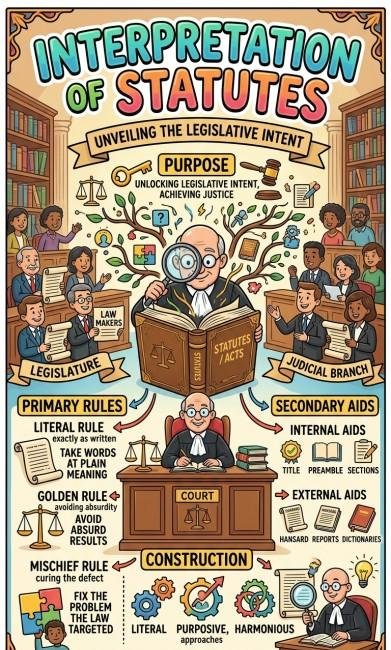
9) LITERAL RULE-
Meaning: Words of a statute are given their ordinary, natural and grammatical meaning.
Principle: If words are clear and unambiguous, court must give them their plain meaning.
Case: Sussex Peerage Case
Advantages: Provides certainty, Predictability, Respects legislature, Limits judicial discretion.
Disadvantages: May cause injustice, can produce absurdity, too rigid.
Conclusion: Literal Rule is the primary rule of interpretation.
10) GOLDEN RULE-
Meaning: Modification of literal meaning to avoid absurdity or injustice.
Principle: If literal interpretation leads to absurdity, court may slightly modify the meaning.
Case: Grey v. Pearson
Importance:
→Avoids absurd results
→Balances literal meaning and justice
→Prevents irrational interpretation.
Conclusion: Golden Rule provides flexibility to prevent injustice.
11) MISCHIEF RULE-
Meaning: Court examines the defect or mischief which the statute intended to remedy.
Origin: Heydon's Case (1584)
Four Questions (Heydon's Case):
→What was the common law before the Act?
→What was the mischief and defect in the law?
→What remedy has the Parliament resolved and appointed?
→What was the reason of the remedy?
Importance:
→Suppresses mischief
→Advances remedy
→Promotes legislative purpose
→Ensures justice.
Conclusion: Mischief Rule focuses on the social purpose of legislation and suppresses the mischief.
12) DIFFERENCE BETWEEN INTERNAL AND EXTERNAL AIDS-
|
Basis |
Internal Aids |
External Aids
|
|
Source |
Within the statute |
Outside the statute
|
|
Nature |
Primary aids |
Secondary aids
|
|
Examples |
Preamble, heading, marginal notes, proviso, punctuation |
Parliamentary history, dictionaries, foreign decisions
|
|
Use |
Clarify meanings of words within Act |
Resolve ambiguity, discover intention
|
Conclusion: Both aids help in proper understanding and interpretation of statutes.
13) DOCTRINE OF PROSPECTIVE OVERRULING-
Meaning: Court's decision applies only to future cases, not to past transactions.
Origin: Developed in USA. Introduced in India in Golaknath v. State of Punjab.
Objective:
→Maintain legal stability
→Prevent hardship
→Protect past transactions
→Promote justice.
Conclusion: Balances judicial innovation and legal certainty.
14) DOCTRINE OF HARMONIOUS CONSTRUCTION-
Meaning: Conflicting provisions of a statute are interpreted harmoniously.
Principle: No provision should become redundant or destroy another provision.
Case: CIT v. Hindustan Bulk Carriers
Importance:
→Maintains consistency
→Avoids conflict
→Preserves legislative intent
→Gives effect to all provisions.
Conclusion: Doctrine ensures unity and coherence in statutes.
15) EJUSDEM GENERIS-
Meaning: General words following specific words take their meaning from the same class.
Conditions:
→Specific words exist;
→Common category exists;
→General words follow;
→No contrary intention.
Example: "Cars, buses, trucks and other vehicles" — "Other vehicles" means vehicles of same type.
Case: Evans v. Cross
16) NOSCITUR A SOCIIS-
Meaning: Meaning of doubtful word can be known from the associated words.
Principle: Context of surrounding words explain doubtful words.
Example: "He killed the snake with his head." — "Head" here means "knowledge" in context.
Case: State of Bombay v. Hospital Mazdoor Sabha
17) DIFFERENCE BETWEEN EJUSDEM GENERIS AND NOSCITUR A SOCIIS-
|
Basis |
Ejusdem Generis |
Noscitur a Sociis
|
|
Meaning |
General words restricted to same class |
Word understood from associated words
|
|
Requirement |
Specific category necessary |
Associated words sufficient |
|
Scope |
Narrower |
Wider
|
18) PRESUMPTIONS
Meaning: Court presumes certain facts unless contrary proved.
Important Presumptions:
→Against retrospective operation
→In favour of constitutionality
→Against ousting jurisdiction
→Against absurdity
→Mens rea is required
19) TYPES OF JURISDICTIONS-
→Territorial Jurisdiction
→Pecuniary Jurisdiction
→Subject-matter Jurisdiction
→Original Jurisdiction
→Appellate Jurisdiction

we believe in a holistic approach to legal education building not just lawyers, but socially conscious leaders of tomorrow.
