INTERPRETATION OF STATUTES- 2 Marks Question/ Answers
TANMOY MUKHERJI INSTITUTE OF JURIDICAL SCIENCE
Dr. Tanmoy Mukherji
Advocate
INTERPRETATION OF STATUTES - 2 MARKS QUESTION / ANSWERS-
Tanmoy Mukherji
Advocate
1.Supreme Legislation:
Supreme legislation is law made by the supreme law-making authority of a sovereign State which cannot be controlled by any other authority.
Example: Acts passed by Parliament in India.
2.Subordinate Legislation:
Subordinate legislation means laws made by authorities under powers delegated by Parliament or Legislature.
Example: Rules, regulations, by-laws.
3.Codifying Legislation:
Codifying legislation consolidates and arranges existing laws systematically into one code.
Example: Indian Penal Code, 1860.
4.Consolidating Legislation:
Consolidating legislation combines different statutes on the same subject into one Act.
Example: Transfer of Property Act.
5.Amending Legislation:
Amending legislation changes, modifies or repeals existing law. Example: Constitution Amendment Acts.
6.Declaratory Legislation:
Declaratory legislation removes doubts regarding existing law.
7.Long Title:
Long title explains the purpose, scope and object of the statute.
8.Short Title:
Short title provides the abbreviated name of the statute. Example: IPC, CPC.
9.Marginal Notes:
Marginal notes are short notes written on the side of sections indicating the subject matter.
10.Heading:
Heading indicates the subject and content of chapter or section.
11.Punctuation:
Punctuation helps determine the grammatical meaning of a statute.
12.Proviso:
Proviso creates an exception or qualification to the main provision.
13.Doctrine of Severability:
If invalid part of statute separable from valid part, only invalid portion becomes void.
Case: R.M.D. Chamarbaugwala Case.
14.Doctrine of Eclipse:
Pre-constitutional law inconsistent with Fundamental Rights becomes dormant, not dead.
Case: Bhikaji Narain v. State of MP.
15.Doctrine of Waiver:
A person voluntarily abandons a legal right.
16.Colourable Legislation:
What legislature cannot do directly; it cannot do indirectly.
17.Perpetual Statute:
Perpetual statute remains in force until repealed.
18.Temporary Statute:
Temporary statute remains effective only for a specified period.
19.Inclusive Definition:
Inclusive definition enlarges the ordinary meaning of a word. Example: "Includes".
20.Exhaustive Definition:
Exhaustive definition completely defines the meaning of the term. Example: "Means".
21.Extensive Definition:
Extensive definition expands the scope of expression beyond ordinary meaning.
22.Restrictive Definition:
Restrictive definition narrows the ordinary meaning of the word.
23.Non-Obstante Clause:
Non obstante clause overrides conflicting provisions.
Example: "Notwithstanding anything contained...".
24.Mens Rea:
Mens rea means guilty mind or guilty intention.
25.Statutes in Pari Materia:
Statutes dealing with the same subject matter are called statutes in pari materia.
26.Legal Fiction:
Legal fiction assumes something false as true for legal purpose.
27.Prospective Operation:
Prospective statute applies to future transactions only.
28.Retrospective Operation:
Retrospective statute applies to past transactions also.
29.Contemporanea Expositio:
Contemporanea Expositio means contemporary interpretation by authorities at the time statute enacted.
30.Mandatory Provision:
Mandatory provision requires strict compliance.
31.Directory Provision:
Directory provision requires substantial compliance only.
32.Conjunctive Words:
Conjunctive words connect expressions jointly.
Example: "And".
33.Disjunctive Words:
Disjunctive words separate expressions alternatively.
Example: "Or".
34.Internal Aids:
Internal aids are aids found within the statute itself.
Examples: Preamble, heading, proviso.
35.External Aids:
External aids are materials outside the statute used for interpretation.
Examples: Parliamentary history, dictionaries.
36.Use of Foreign Decisions:
Foreign judgments may be used as persuasive authority in interpretation.
37.Use of International Treaties:
Courts may use international conventions to interpret domestic statutes where no inconsistency exists.
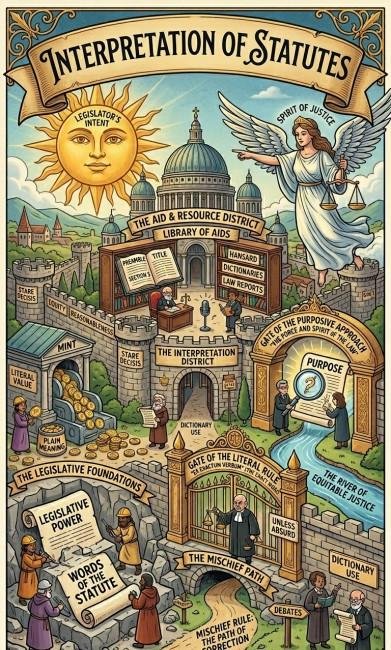
38.Literal Rule:
Words must be given their ordinary grammatical meaning.
Case: Sussex Peerage Case.
39.Golden Rule:
Modification of literal meaning to avoid absurdity.
Case: Grey v. Pearson.
40.Mischief Rule:
Court examines the defect or mischief the statute intended to remedy.
Case: Heydon's Case.
41.Ejusdem Generis:
General words following specific words take meaning from the same class.
42.Noscitur a Sociis:
Meaning of a word is understood from its surrounding words.
43.Reddendo Singula Singulis:
Words in a statute are distributed and referred to their respective subjects.
44.Ut Res Magis Valeat:
Interpretation should make the statute effective rather than void.
45.Sententia Legis:
Sententia legis means the spirit or intention of law.
46.Ex Visceribus Actus:
Statute must be read as a whole and not in parts.
47.Presumption:
Court assumes certain facts unless contrary proved.
48.Jurisdiction:
Jurisdiction means legal authority of court to hear and decide cases.
49.Exclusion of Jurisdiction:
When statute bars the jurisdiction of ordinary courts.
50.Judicial Review:
Power of courts to examine legality and constitutionality of laws and administrative actions.

we believe in a holistic approach to legal education building not just lawyers, but socially conscious leaders of tomorrow.
