INDIAN ECONOMY AND PUBLIC POLICY-
Dr. Tanmoy Mukherji
Advocate
INDIAN ECONOMY AND PUBLIC POLICY-
Tanmoy Mukherji
Advocate
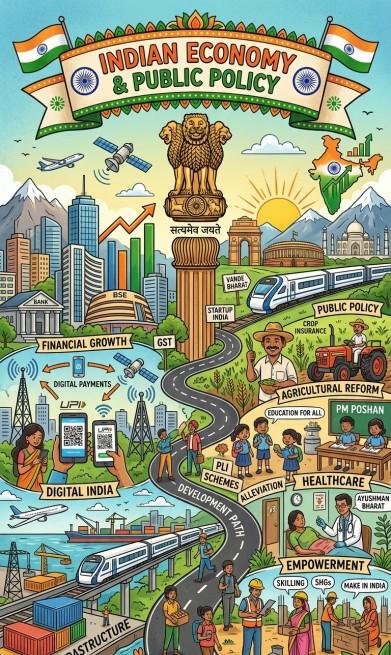
Public policy in India is deeply influenced by the economic goals of the nation. Economic policies are framed to promote growth, reduce inequality, ensure social justice and achieve sustainable development.
1. RELATIONSHIP BETWEEN ECONOMY AND PUBLIC POLICY-
→Economy provides resources for public policy.
→Public policy regulates economic activities for public welfare.
→Strong economy enables better delivery of public services.
→Policies aim at balanced growth and inclusive development.
→Economic conditions influence the priority of policies.
2. GOALS OF ECONOMIC POLICY-
Economic Growth: Increase in production, income and employment.
Employment Generation: Creating more jobs and reducing unemployment.
Price Stability: Controlling inflation and ensuring price stability.
Equity and Social Justice: Reducing income inequality and regional disparities.
Sustainable Development: Balanced growth with environmental protection.
3. KEY AREAS OF ECONOMIC PUBLIC POLICY IN INDIA-
Fiscal Policy: Government taxation and expenditure to influence the economy.
Monetary Policy: Control of money supply, interest rates and credit by RBI.
Industrial Policy: Promotion of industries, regulation and support to key sectors.
Trade Policy: Regulation of imports, exports and foreign trade.
Agricultural Policy: Improving agriculture productivity, farmer income and rural development.
Infrastructure Policy: Investment in transport, power, digital and social infrastructure.
Social Welfare Policy: Spending on education, health, food security, housing and social protection.
4. IMPORTANT ECONOMIC POLICIES AND INITIATIVES-
Liberalization, Privatization, Globalization (1991): Reduced government control and opened the economy to global markets.
Make in India: Promotes manufacturing and attracts investment in key sectors.
Atmanirbhar Bharat: Self-reliant India initiative to boost domestic production and reduce dependence on imports.
Goods and Services Tax (GST): Unified tax system to promote ease of doing business and increase tax compliance.
MUDRA Yojana: Provides loans to small and micro enterprises and promotes entrepreneurship.
PM Awas Yojana: Affordable housing for all and boosting the real estate sector.
5. IMPACT OF ECONOMIC POLICIES-
POSITIVE IMPACT
→Higher GDP growth
→Increase in employment
→Growth of industries and services
→Better infrastructure
→Poverty reduction
→Improved living standards
CHALLENGES-
→Income inequality
→Unemployment among youth
→Rising inflation
→Regional imbalance
→Environmental degradation
→Dependence on global markets.
6. CHALLENGES IN FRAMING ECONOMIC POLICIES-
→Diverse economic conditions across states.
→Rapid population growth and pressure on resources.
→Global economic uncertainty and external shocks.
→Balancing growth with social justice.
→Ensuring sustainable development.
7. WAY FORWARD-
→Inclusive and people-centric policies
→Investment in education, health and skills
→Promote innovation, entrepreneurship and MSMEs
→Strengthen public-private partnerships and good governance
→Balanced growth with environmental sustainability
CONCLUSION-
Indian economy and public policy are interconnected. Well-designed economic policies promote growth, create opportunities and ensure social welfare. The goal is to achieve a strong, inclusive, sustainable and self-reliant India.

we believe in a holistic approach to legal education building not just lawyers, but socially conscious leaders of tomorrow.
