The importance of NAAC for the higher education institution
TANMOY MUKHERJI INSTITUTE OF JURIDICAL SCIENCE
Dr. Tanmoy Mukherji
Advocate
The importance of NAAC for the higher education institution-
Tanmoy Mukherji
Advocate

The National Assessment and Accreditation Council (NAAC) is an autonomous body established in 1994 by the University Grants Commission (UGC) to assess and accredit higher education institutions (HEIs) in India.
NAAC plays a crucial role in maintaining and improving the quality of higher education by evaluating institutions on defined academic and administrative parameters.
Objectives of NAAC-

Legal and Regulatory Framework-
→NAAC operates under the framework of the University Grants Commission Act.
→Under Section 12 of the Act, UGC is empowered to determine and maintain standards of higher education, and NAAC functions as its quality assurance arm.
Assessment Criteria of NAAC-

Institutions are graded as:
→A++
→A+
→A
→B++ etc.
Importance of NAAC for Higher Education Institution-
Quality Assurance-
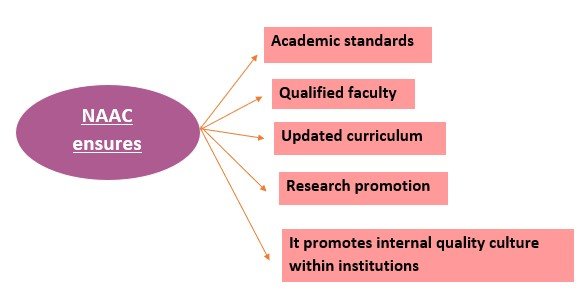
Eligibility for Grants & Funding-

Institutional Reputation & Ranking-

Accountability & Transparency-
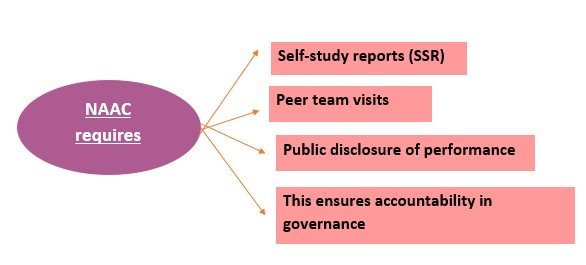
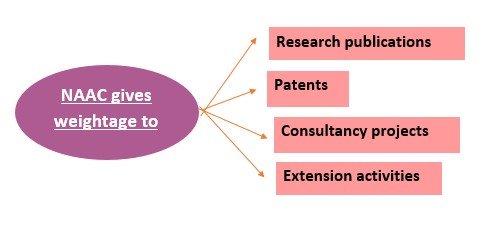
Encouragement of Research & Innovation-
Student Benefits-

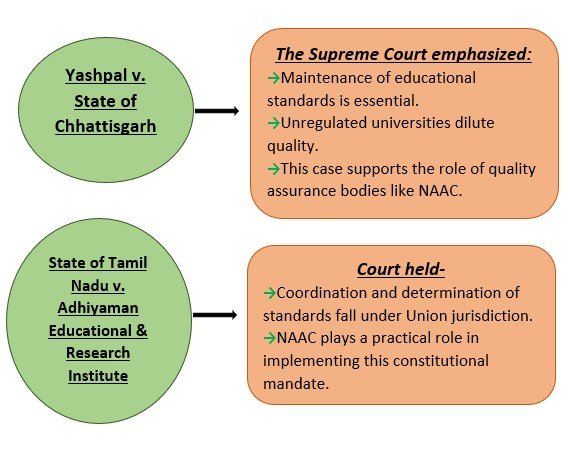
Judicial Perspective on Educational Standards-
Important Case:
Criticism of NAAC-
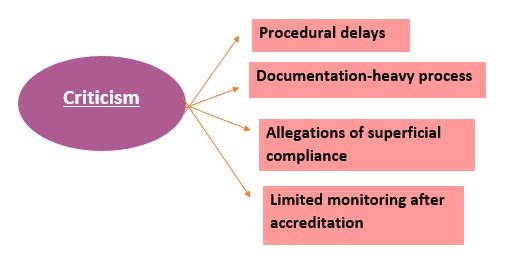
Recent Reforms-
Under National Education Policy (NEP) 2020:
→Proposal for new accreditation framework
→Technology-driven evaluation
→Outcome-based assessment
→NAAC is being restructured to ensure transparency and digitalization.
NAAC is a cornerstone of quality assurance in Indian higher education. It promotes academic excellence, institutional accountability, research development, and global competitiveness. Despite challenges, NAAC significantly contributes to improving standards and credibility of higher education institutions in India.

we believe in a holistic approach to legal education building not just lawyers, but socially conscious leaders of tomorrow.
