ENVIRONMENTAL POLICY AND EDUCATION POLICY IN INDIA
Dr. Tanmoy Mukherji
Advocate
ENVIRONMENTAL POLICY AND EDUCATION POLICY IN INDIA-
Tanmoy Mukherji
Advocate
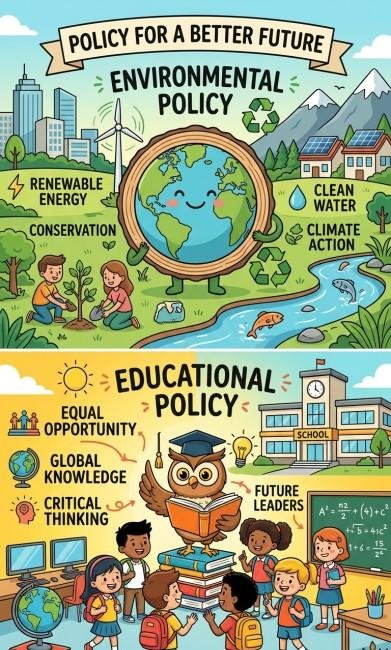
Public policy in India aims to protect the environment for sustainable development and provide quality education for all to promote human resource development and social transformation.
A. ENVIRONMENTAL POLICY-
MEANING-
Environmental policy refers to government actions and regulations to protect and improve the environment and ensure sustainable development.
OBJECTIVES-
→Conservation of natural resources
→Prevention of pollution
→Maintenance of ecological balance
→Promotion of sustainable development
→Climate change mitigation
IMPORTANT ENVIRONMENTAL POLICIES AND LAWS IN INDIA-
Environment (Protection) Act, 1986 – Umbrella law for environment protection.
Forest (Conservation) Act, 1980 – Conservation of forests and prevention of deforestation.
Wildlife (Protection) Act, 1972 – Protection of wild animals, birds and their habitats.
Water (Prevention and Control of Pollution) Act, 1974 – Prevention and control of water pollution.
Air (Prevention and Control of Pollution) Act, 1981 – Prevention and control of air pollution.
Biological Diversity Act, 2002 – Conservation of biological diversity and sustainable use of its components.
National Green Tribunal Act, 2010 – Effective and speedy disposal of environmental cases.
KEY ENVIRONMENTAL INITIATIVES-
→National Action Plan on Climate Change (NAPCC)
→Swachh Bharat Abhiyan
→Namami Gange
→National Afforestation Programme
→LIFE - Lifestyle for Environment
CHALLENGES-
→Pollution and waste management
→Deforestation and loss of biodiversity
→Climate change and global warming
→Rapid urbanization and industrialization
→Lack of public awareness and participation
B. EDUCATION POLICY-
MEANING-
Education policy refers to government decisions and plans related to the development, promotion and regulation of education in the country.
OBJECTIVES-
→Universal access to quality education
→Equity and inclusion
→Development of skills and values
→Promotion of research and innovation
→Nation building and social empowerment
MAJOR EDUCATION POLICIES IN INDIA-
National Education Policy (NEP) 2020 – Holistic and multidisciplinary education, flexibility, 5+3+3+4 structure, emphasis on skills, values and technology.
Right of Children to Free and Compulsory Education Act, 2009 – Ensures free and compulsory education for children aged 6-14 years.
Sarva Shiksha Abhiyan (SSA) – Universalization of elementary education.
Rashtriya Madhyamik Shiksha Abhiyan (RMSA) – Improvement of secondary education.
Mid-Day Meal Scheme – Improve nutrition and promote school attendance.
Skill India Mission – Promoting skill development and vocational education.
KEY FEATURES OF NEP 2020-
→Foundation Stage (3-8 years)
→5+3+3+4 Curricular Structure
→Multilingualism and Indian Languages
→Focus on Skills and Vocational Education
→Holistic and Multidisciplinary Education
→Technology Integration
→Equity and Inclusion
→Continuous Assessment
CHALLENGES-
→Inequality in access and quality
→Inadequate infrastructure and facilities
→Shortage of trained teachers
→Digital divide
→Need for curriculum reform and employability.
C. IMPORTANCE OF BOTH POLICIES-
→Environmental policy ensures a healthy environment for present and future generations.
→Education policy builds human capital and promotes social and economic development.
→Both policies support sustainable development and improve quality of life.
→Together they create a responsible, skilled and aware citizenry for a better India.
→They are essential for achieving inclusive growth and a developed nation.
CONCLUSION-
Environmental policy and education policy are two pillars of national development. While environmental policy protects our natural resources and ensures sustainability, education policy empowers individuals and transforms society. Effective implementation of both is crucial for a prosperous, equitable and sustainable India.

we believe in a holistic approach to legal education building not just lawyers, but socially conscious leaders of tomorrow.
