Doctrine of Renvoi
TANMOY MUKHERJI INSTITUTE OF JURIDICAL SCIENCE
Dr. Tanmoy Mukherji
Advocate
Doctrine of Renvoi-
Tanmoy Mukherji
Advocate
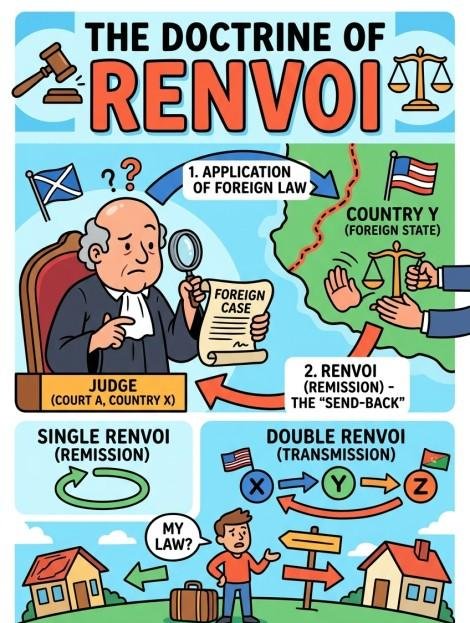
The doctrine of Renvoi is a significant and often debated principle of Private International law (conflict of laws). It arises in cases involving a foreign element, such as domicile, nationality, marriage, succession or property situated abroad. Whenever a court is required to apply the law of another country, a fundamental question emerges-
→Does the reference to foreign law mean only the internal substantive law of that country? or
→Does it include the entire legal system including its conflict of law rules?
It arises when a court refers a matter to a foreign legal system and must decide whether to apply-
→only the internal law of that country;
→The whole of (including its conflicting rules).
Every legal system has two components-
Internal Law - Governs substantive rights
Conflict Rules - Decide which country's law applies.
Renvoi becomes relevant only when the forum Court adopts the whole law theory.
Nature and Importance:
Renvoi highlights the inherent complexity of international legal disputes in a globalized world where individuals-
→across borders
→own property in multiple jurisdictions
→change domicile or nationality
Courts frequently face cases involving more than one legal system.
Without renvoi Courts may reach different conclusions in different countries regarding the same disputes.
The doctrine attempts to address-
→International uniformity of decisions;
→Respect for foreign law.
→Avoidance of contradictory judgments
Philosophical Basis:
The doctrine is rooted in two competing approaches:
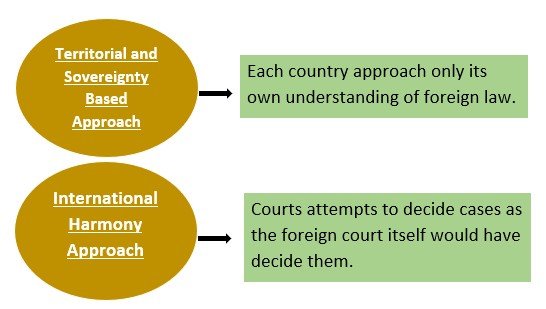
Renvoi reflects the second approach. It attempts to ensure that the outcome of a dispute remain consistent regardless of the forum in which it is decided.
Practical content-
Renvoi most commonly arises in matters relating to:
→succession of property
→Domicile
→legitimacy of child
→Validity of marriage
It is generally avoided in commercial and contractual matters because certainty and predictability are more important in business transaction.
Significance:
The doctrine of renvoi represents the tension, between-
→Simplicity and certainty.
→International consistency and justice.
While some legal system accepts renvoi, others reject it due to its complexity and potential for circular reasoning.
Logical Structure of Renvoi-
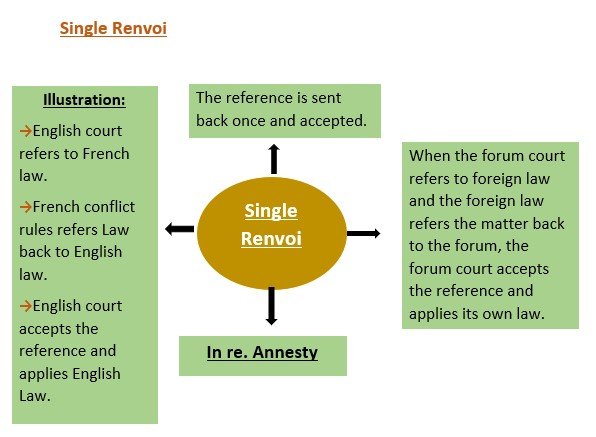
Suppose-
→English court deciding succession.
→ English conflict rule, says-Apply law of Domicile →French law.
→French conflict rule says - Apply National law →English Law.
Now, English Court must decide-
→Should it ignore French conflict rules?
→Should it accept, the reference back?
The dilemma creates the doctrine of renvoi.
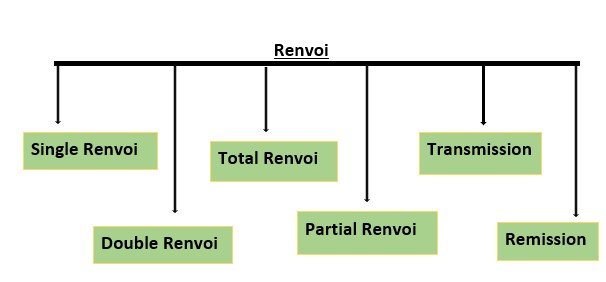
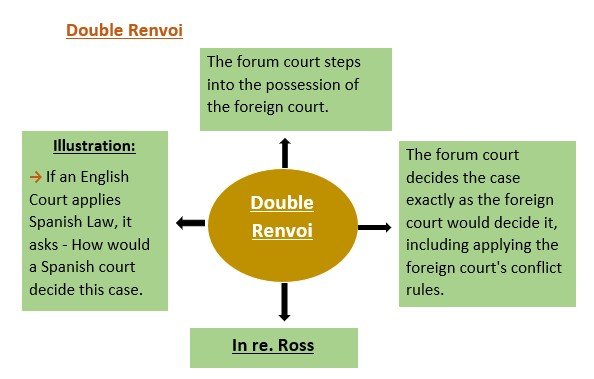
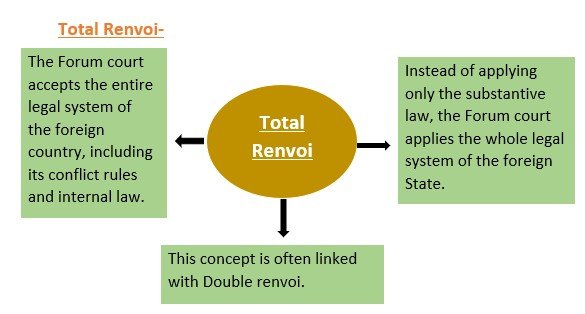
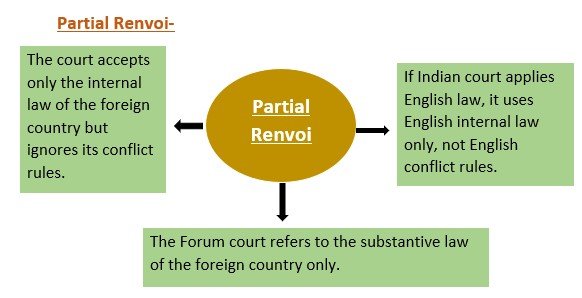
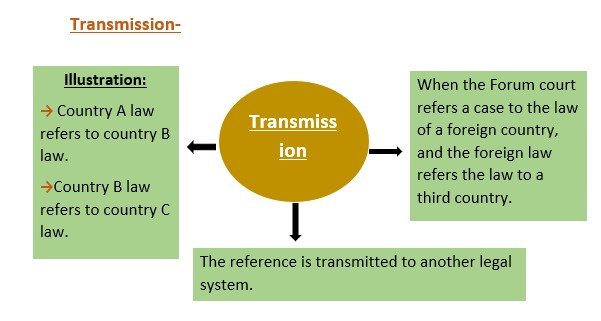
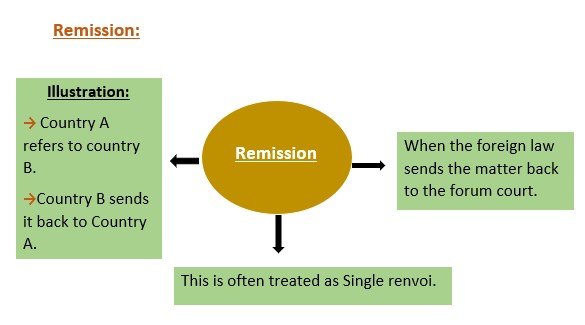
Types of Renvoi-

we believe in a holistic approach to legal education building not just lawyers, but socially conscious leaders of tomorrow.
