DIFFERENCE BETWEEN TESTAMENTARY SUCCESSION and INTESTATE SUCCESSION-
Dr. Tanmoy Mukherji
Advocate
DIFFERENCE BETWEEN TESTAMENTARY SUCCESSION and INTESTATE SUCCESSION-
Tanmoy Mukherji
Advocate
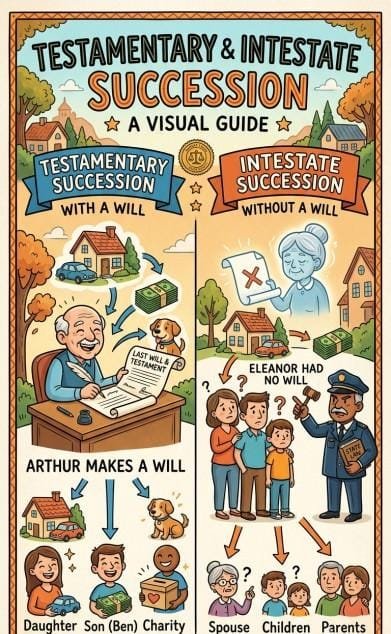
Succession means the transmission of the property, rights and interests of a deceased person to another person after death.
|
BASIS |
TESTAMENTARY SUCCESSION |
INTESTATE SUCCESSION
|
|
Meaning |
Succession according to a valid Will or testamentary disposition. |
Succession by operation of law where the deceased dies intestate regarding the property concerned.
|
|
Basis |
Intention (last wishes) of the deceased. |
Rules prescribed by law.
|
|
Will |
Requires an effective testamentary disposition. |
Operates where there is no effective testamentary disposition of the property.
|
|
Person making disposition |
Called Testator (or Testatrix). |
There is no testator in relation to intestate property.
|
|
Person receiving property |
Usually called Legatee or Beneficiary. |
Called Heir or Legal Heir.
|
|
Choice |
Subject to legal restrictions, the testator chooses the beneficiary. |
The deceased does not choose; the law determines who will succeed.
|
|
Time of operation |
Will operates upon the death of the testator. |
Statutory succession opens on death.
|
|
Revocability |
Will is ambulatory and can be revoked or altered during the testator's lifetime (Section 62, ISA). |
No question of revocation by the deceased; statutory rules apply when succession opens.
|
|
Distribution |
According to the terms of the valid Will. |
According to statutory order and shares.
|
|
Relevant Law (Hindus) |
Section 30, Hindu Succession Act, 1956 – Testamentary disposition by a Hindu. |
Male: Sections 8–13 HSA Female: Sections 15–16 HSA Failure of heirs: Section 29 HSA (property to Government)
|
|
Proof / Procedure |
Will must satisfy statutory requirements of execution (Sec. 63, ISA) and proof. Probate/Letters of Administration may be required. |
Questions mainly about death, relationship/status of heirs, nature of property and applicable succession rules. Succession Certificate / Letters of Administration may apply.
|
|
Partial succession |
A Will can dispose of only part of the estate. |
Property not effectively disposed of by Will devolves intestate.
|
|
Failure / Invalidity |
If Will is invalid or ineffective, property concerned devolves intestate. |
Statutory succession supplies the rule of devolution. |
|
Ultimate failure of heirs (Hindus) |
Normally not applicable while Will governs the property. |
On complete failure of qualified heirs, property devolves on Government (Section 29 HSA).
|
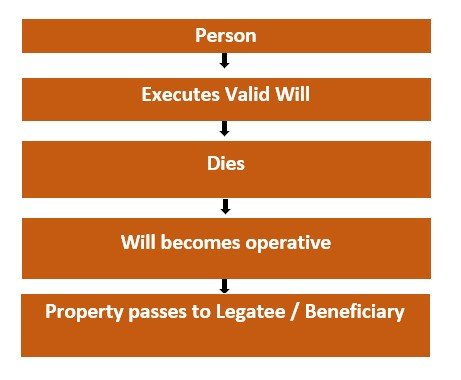
TESTAMENTARY SUCCESSION- Flow Chart-
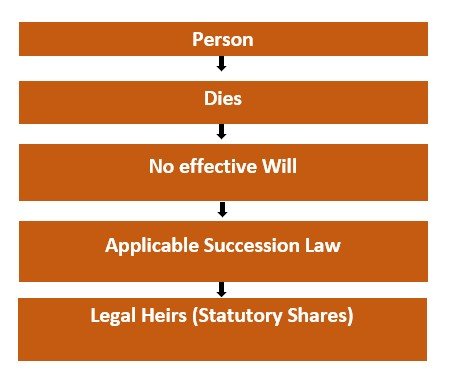
INTESTATE SUCCESSION Flow Chart-
★ IMPORTANT-
A person may die PARTLY TESTATE and PARTLY INTESTATE.
Property disposed of by Will → Testamentary Succession.
Property not disposed of by Will → Intestate Succession.
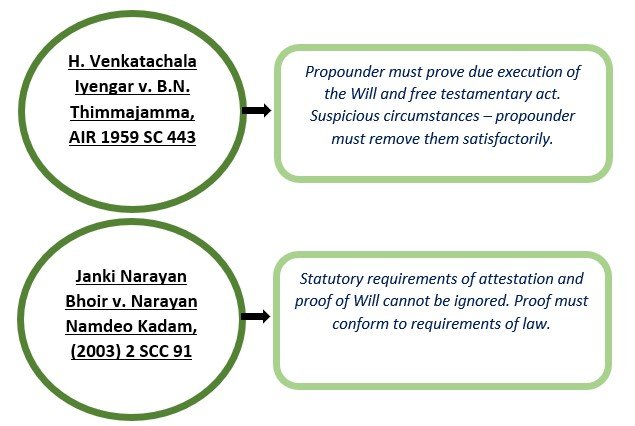
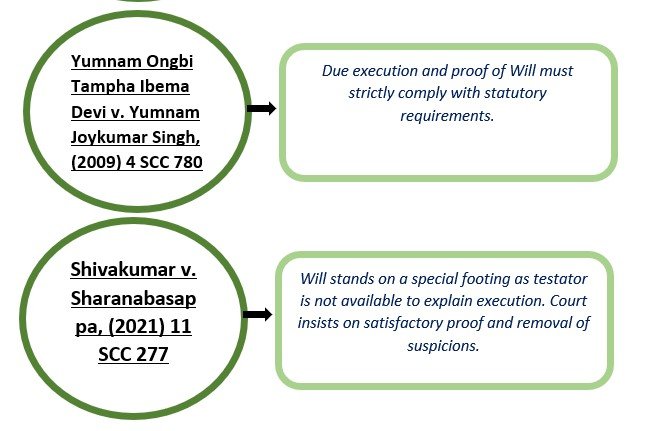
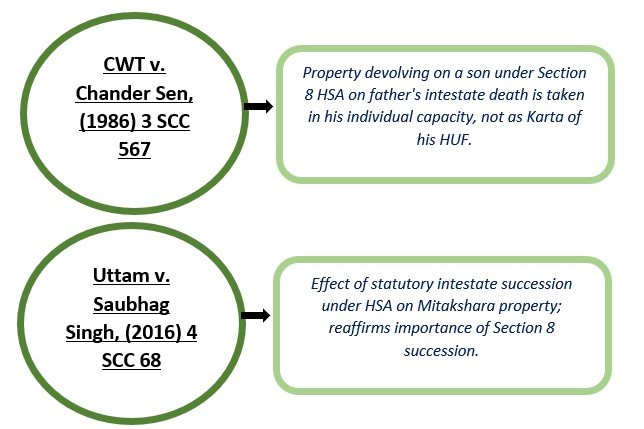
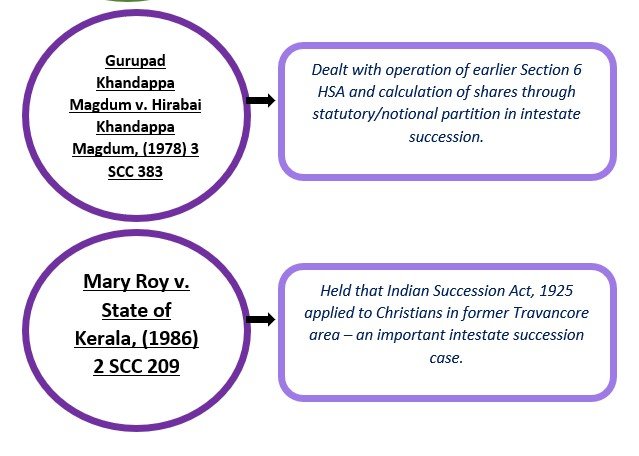
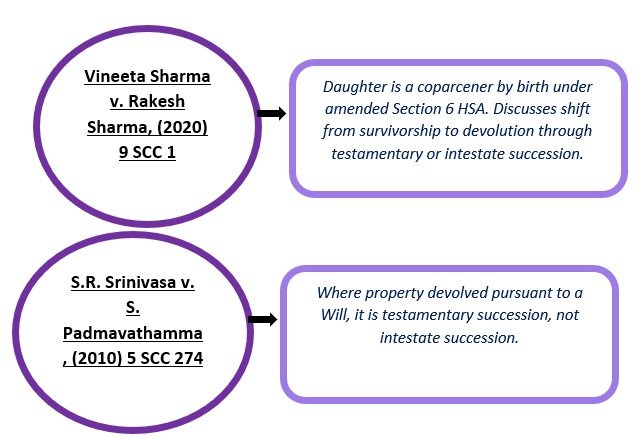
IMPORTANT CASE LAWS-
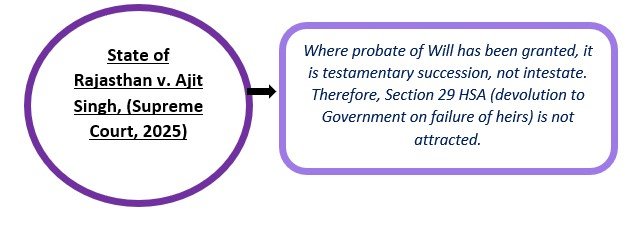
PARTIAL INTESTACY -Example-
A owns: House + Land + ₹10 lakh deposit
A's Will: "I give my house to B."
If Will makes no disposition of land and deposit:
House → Will → B (Testamentary Succession)
Land + Deposit → Law → Heirs (Intestate Succession)
ONE-LINE DISTINCTION-
Testamentary succession is devolution according to the legally effective testamentary intention of the deceased; intestate succession is devolution by operation of the applicable law in the absence of an effective testamentary disposition governing the property.
|
TESTAMENTARY SUCCESSION |
INTESTATE SUCCESSION
|
|
WILL → TESTATOR → LEGATEE → INTENTION
|
NO EFFECTIVE WILL → STATUTE / PERSONAL LAW → HEIRS → STATUTORY SHARE
|
STATUTES-
→Sec. 30, Hindu Succession Act, 1956
→Sec. 8-13, HSA (Male Intestate)
→Sec. 15-16, HSA (Female Intestate)
→Sec. 29, HSA (Devolution to Govt.)
→Sec. 59-63, Indian Succession Act, 1925 (Wills).

we believe in a holistic approach to legal education building not just lawyers, but socially conscious leaders of tomorrow.
