Difference Between Criminal Misappropriation Criminal Breach of Trust
Dr. Tanmoy Mukherji
Advocate
Difference Between Criminal Misappropriation Criminal Breach of Trust-
Tanmoy Mukherji
Advocate
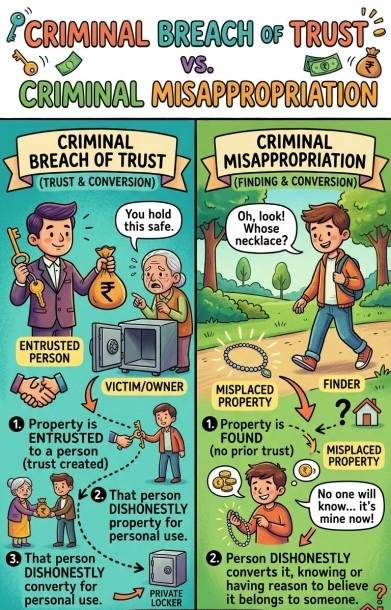
|
Criminal Misappropriation |
Criminal Breach of Trust |
|
Sec. 314 defines criminal misappropriation.
|
Sec 316 defines criminal breach of trust.
|
|
According to Sec. 314, Whoever dishonestly misappropriates or converts to his own use any movable property, shall be punished with imprisonment of either description for a term which shall not be less than six months but which may extend to two years & with fine.
|
According to Sec. 316, whoever being in any manner entrusted with any property, or dominion over property, dishonestly misappropriates or converts to his own use that property or dishonestly uses or disposes of that property in violation of any direction of law prescribing the mode in which such trust is to be discharged, or of any legal contract, expressed or implied, which he has made touching the discharge of such trust or willfully suffers any other person so to do, commits criminal breach of trust.
|
|
No entrustment required
|
Entrustment is essential
|
|
Property comes into possession by accident or otherwise.
|
Property is given intentionally
|
|
Focus on conversion |
Focus on violation of trust
|
|
Simple offense |
More serious offense |
|
No fiduciary relationship
|
Fiduciary relationship exists.
|
|
Example: - Finding lost property & keeping it
|
Example: - Trustee misusing funds
|
|
Initial possession may be innocent.
|
Initial possession is lawful.
|
|
Dishonestly arises later.
|
Dishonestly arises during misuse.
|
|
No Contractual duty generally involves.
|
often involves contractual or legal duty.
|
|
Lower punishment.
|
Higher punishment.
|
|
Ownership not transferred. |
Property entrusted for purpose.
|
|
Less moral blameworthiness
|
Higher moral blameworthiness
|
|
Can occur without relationship. |
Requires relationship (Agent, trustee etc).
|
|
Applies to finder of goods.
|
Applies to bailee, agent, trustee.
|
|
No obligation to return initially.
|
Obligation to return property.
|
|
Simple proof required.
|
Requires proof of entrustment + breach.
|
|
No specific direction needed.
|
Violation of direction of law or contract.
|
|
Ramaswamy Nadar v. State of Madras.
|
R.K Dalmia v. Delhi Administration.
|

we believe in a holistic approach to legal education building not just lawyers, but socially conscious leaders of tomorrow.
