Difference Between Abetment & Criminal Conspiracy-
Dr. Tanmoy Mukherji
Advocate
Difference Between Abetment & Criminal Conspiracy-
Tanmoy Mukherji
Advocate
|
Basis
|
Abetment |
Criminal Conspiracy |
|
Section
|
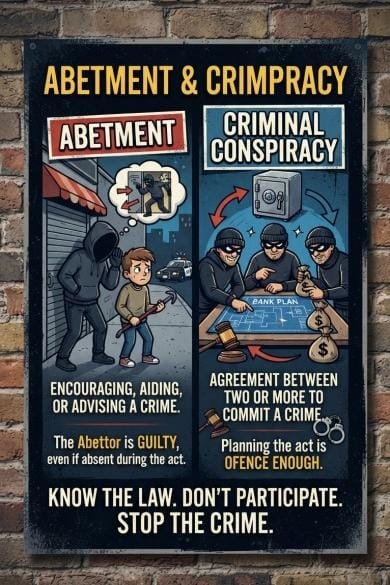
Sec 45, BNS defines abetment
|
Sec 61 of BNS defines criminal conspiracy |
|
Definition
|
Intentionally instigating, engaging in conspiracy for abetment, or intentionally aiding another to commit an offence.
|
An agreement between two or more persons, to commit an illegal act or a legal act by illegal means. |
|
Essence of the Offence
|
Instigation, conspiracy for abetment, or intentional aid.
|
The unlawful agreement itself.
|
|
Number of Persons Required
|
One abettor can abet another person.
|
At least 2 persons are essential. |
|
Agreement required
|
Not always. It may occur by instigation or intentional aid alone. |
Agreement is mandatory. |
|
Need for instigation
|
Yes, instigation is one recognized mode.
|
Instigation is not necessary. |
|
Need for intentional aid
|
Yes, intentional aid is another recognized mode.
|
Not required. |
|
Completion of Offence
|
Complete when the act of abetment is committed, even if the principal offence is not always completed (Subject to statutory provision).
|
Complete as soon as the unlawful agreement is formed (For conspiracies to commit offences, in other cases, an overt act may also be required).
|
|
Participation
|
The abettor may not actively participate in committing the principal offence.
|
Every conspirator participates in the common design through the agreement. |
|
Proved
|
Can be proved through evidence of instigation, aid or conduct.
|
Usually proved through circumstantial evidence because direct evidence of the agreement is rare. |
|
Object
|
To encourage or assist another person in committing an offence.
|
To jointly plan and execute an illegal objective.
|
|
Punishment
|
Depends on the offence abetted and the applicable BNS provisions.
|
Punishment depends on the object of the conspiracy and the applicable BNS provisions.
|
|
Liability
|
Liability arises from the act of abetting.
|
Liability arises from being a party to the unlawful agreement.
|
|
Withdrawal
|
Mere withdrawal after abetment may not absolve liability once the offence of abetment is complete.
|
Withdrawal may reduce future involvement, but liability for the conspiracy already formed can remain.
|
|
Scope
|
Wider concept because it includes instigation, conspiracy and intentional aid.
|
Narrower, focusing specially on unlawful agreement.
|

we believe in a holistic approach to legal education building not just lawyers, but socially conscious leaders of tomorrow.
