Constitutional Provisions regarding the Protection of Environment
Constitutional Provisions regarding the Protection of Environment-
Tanmoy Mukherji
[Advocate]
The Constitution of India is not an inert but a living document which evolves and grows with time. The specific provisions on environment protection in the Constitution are also result of this evolving nature and growth potential of the fundamental law of the land.
With the signing of the Stockholm Declaration in 1972, India was a signatory to such International Pacts and carried on many amendments in the Constitution to include many Articles protecting the environment. Currently, the Indian Constitution recognizes many direct and indirect provisions for the protection of environment.
Preamble of the Indian Constitution-
-The Preamble to our Constitution ensures "Socialist" pattern of the society and "Dignity of the Individual".
-Decent standard of living and pollution free environment is inherent in this Preamble.
- Though, India has always been following the ideal of socialistic and secular society yet it was for the first time that the ideal was given a Constitutional recognition by the 42nd Amendment Act, 1976.
Fundamental Rights and Environmental Protections-
Article 14- "State shall not deny to any person equality before laws or equal protection of the laws within the territory of India."
This right can also be affected when the Government makes laws that have an adverse effect on the environment hence Art-14, in an indirect way, protects the environment. It also casts a duty on the State, as defined in Article 12 to utilize their discretionary powers without infringing the interest of the general public even in the area of the environment.
Article 19(1) (a) - Every citizen of India has freedom of speech and expression guaranteed to it, under Article 19(1) (a).
The media plays a very important role in moulding the views and opinions of people in matters concerning the environment. It can be interpreted to include freedom of the press.
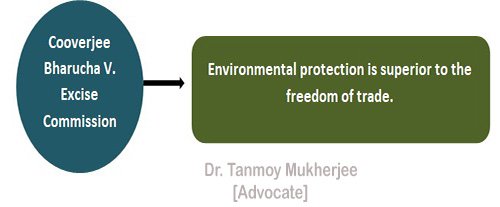
Article 19(1)(g)- Every citizen of India has the right to choose, practice and profess the profession or business of their choice. But like all other fundamental rights, it is not absolute.
It is subject to restrictions provided under Article 19(6); one of these restrictions is regarding the environmental hazards.
Article 21-
Says that, "No person shall be deprived of his life or personal liberty except according to procedure established by law."
Right to life means a person has a right to life with dignity and not a mere animal existence. This Article from time and time again has been expanded by the Supreme Court of India.
Article 25-
Article 25(1) says that subject to public order, morality and health and to the other provisions of Part-III, all persons are equally entitled to freedom of conscience and the right to freedom of profess, practice and propagate religion.
Article 32-
An aggrieved party may go the Supreme Court for the enforcement of the Fundamental rights mention in Part-III.
DPSPs and Environmental Protection-
Article-42- says that the State shall make provision for securing just and human conditions of work and for maternity leave.
Article 43- Securing living wages is not enough. State should endeavor to ensure decent standards of life.
Article 47- The duty of the state is to raise the level of nutrition and the standard of living and to improve the public health.
Article 48- Says that, the State shall endeavor to organize agriculture and animal husbandry on modern and scientific lines and shall, in particular, take steps for preserving and improving the breeds, and prohibiting the slaughter of cows and calves and other milch and draught cattle.
Article 48A- Says that, the State shall endeavor to protect and improve the environment and to safeguard the forests and wild life of the country.
Article 49- Says that, it shall be the obligation of the state to protect every monument or place or object of artistic or historic interest.
Fundamental Duties and Environmental Protection-
Article 51A (g)- It shall be duty of the every citizen of India to protect and improve the natural environment including, forests, lakes, rivers, and wild life, and to have compassion for living creatures.
Other Provisions-
Article 226- An aggrieved party may go to the High Court under Art 226 for the enforcement of Fundamental rights and any other rights.
Article 253 - Parliament has power to make any law for the whole or any part of the territory of India for implementing any treaty.
Schedule VII-
List - I (Union List)-
|
Entry
|
Subject
|
|
1 |
Atomic Energy and Mineral Resources necessary for its Production.
|
|
14 |
Entering into treaties and agreements with foreign countries.
|
|
24 |
Shipping and navigation on island waterways, declared by Parliament by law.
|
|
25 |
Provision of education and training for the mercantile marine and regulation.
|
|
29 |
Provision of aerodromes, regulation and organization of air traffic.
|
|
52 |
Provisions for controlling industries.
|
|
53 |
Regulation and development of oil-fields and mineral oil resources.
|
|
54 |
Regulation of mines and mineral development.
|
|
56 |
Regulation and development of inter-state rivers and river valleys.
|
|
57 |
Fishing and fisheries beyond territorial water.
|
List-II (State List)-
|
Entry
|
Subject
|
|
6 |
Public health and sanitation, hospitals and dispensaries.
|
|
10 |
Burials and burial grounds, cremations and cremation grounds.
|
|
14 |
Agriculture, including agricultural education.
|
|
15 |
Veterinary, training and practice, preservation, and protection of stock and prevention of animal diseases.
|
|
17 |
Water, water supplies, canals, irrigation, drainage and embankments, water storage and water power.
|
|
18 |
Land and land tenures including the relation of landlord and tenant or alienation of agricultural land, agricultural farms.
|
|
21 |
Fisheries.
|
List III (Concurrent list)-
|
Entry
|
Subject
|
|
17 |
Prevention of cruelty to animals.
|
|
17A |
Forests.
|
|
17B |
Protection of wild animals and birds.
|
|
18 |
Adulteration of foodstuffs and other goods.
|
|
19 |
Drugs and poisons.
|
|
20 |
Economic and social planning.
|
|
20A |
Population control and family planning.
|
|
29 |
Prevention of infectious or contagious diseases or pests affecting men, animal or plants.
|
|
31 |
Ports.
|
|
36 |
Factories.
|
|
37 |
Boilers.
|
|
40 |
Archaeological sites and remains
|

we believe in a holistic approach to legal education building not just lawyers, but socially conscious leaders of tomorrow.
