The budgetary allocation of Central Government on education in India
Dr. Tanmoy Mukherji
Advocate
The budgetary allocation of Central Government on education in India-
Tanmoy Mukherji
Advocate
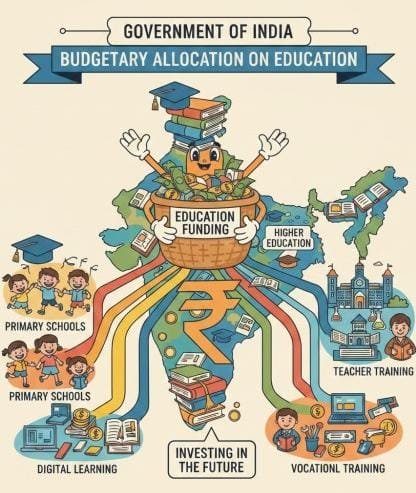
Education is the backbone of socio-economic development and constitutional democracy. The Central Government allocates funds annually through the Union Budget to implement constitutional mandates such as Article 21A (Right to Education) and Directive Principles under Articles 41, 45 and 46.
The allocation is made through the Ministry of Education, which has two departments:
→Department of School Education & Literacy
→Department of Higher Education
Constitutional and Policy Framework-
Budgetary allocation is guided by:
Article 21A – Free and compulsory education (6–14 years).
Article 45 – Early childhood care and education.
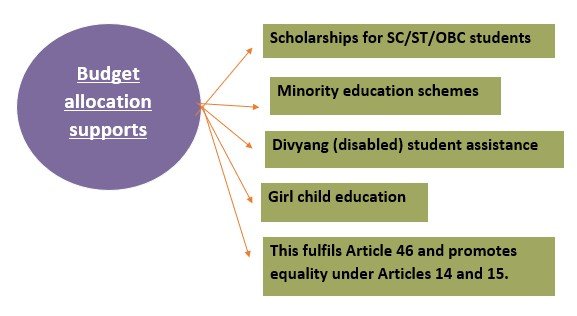
Article 46 – Promotion of SC/ST and weaker sections.
Education in Concurrent List (42nd Amendment, 1976).
The National Education Policy recommends public investment in education to reach 6% of GDP, a recommendation earlier made by the Kothari Commission (1966).
Overall Budgetary Trend-
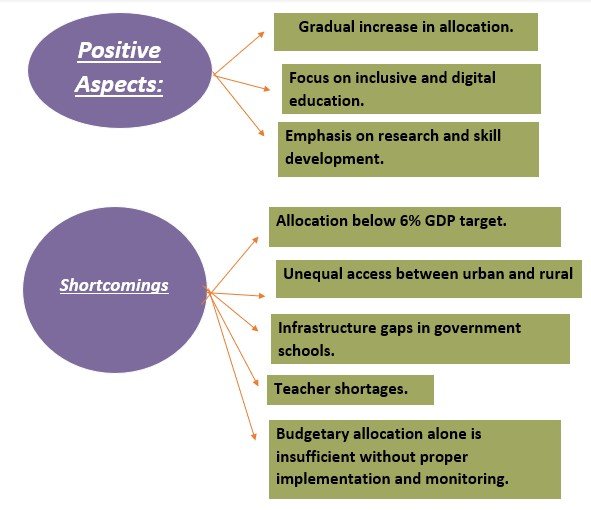
→Education typically receives around 2.5–3% of GDP, below the 6% target.
→Allocation increases yearly in absolute terms but remains limited in GDP percentage.
→School education receives a larger share compared to higher education.
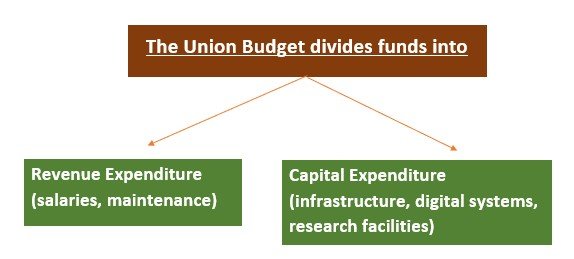
Allocation for School Education-
The Department of School Education & Literacy receives the highest share.
Major Schemes:
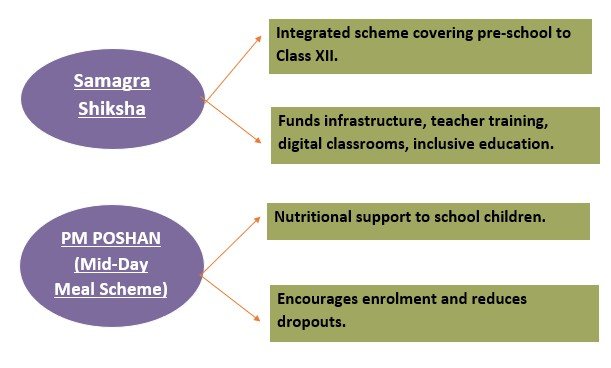
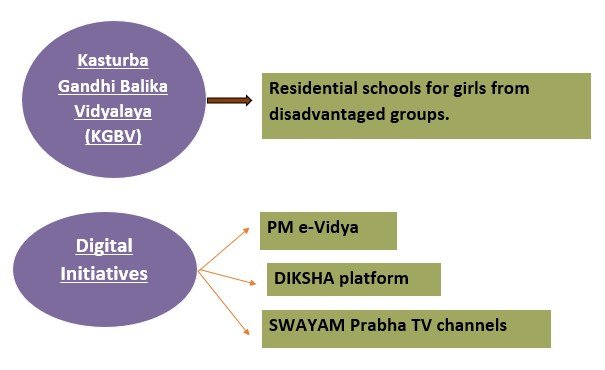
The focus areas include:
→Universal access
→Gender parity
→Reduction in dropout rate
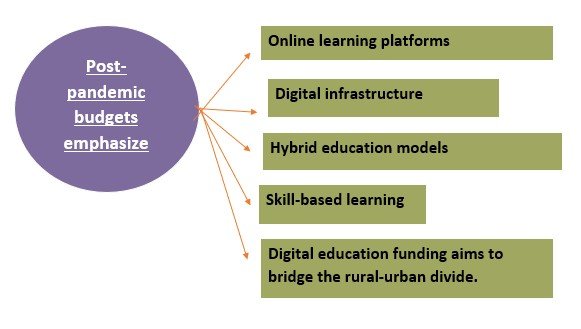
→Digital inclusion
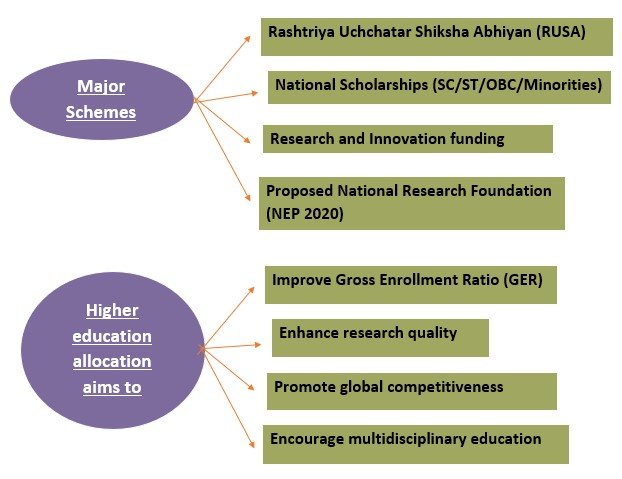
Allocation for Higher Education-
The Department of Higher Education funds universities, research institutions, and professional education.
Key Regulatory and Funding Bodies:
→University Grants Commission (UGC) – Grants and coordination.
→All India Council for Technical Education (AICTE) – Technical education regulation.
→Central Universities, IITs, NITs, IISERs.
Centrally Sponsored Schemes (CSS)-
In many schemes, funding is shared between Centre and States (e.g., 60:40 ratio; 90:10 for special category states). This ensures cooperative federalism in education governance.
Social Justice and Inclusive Education-
COVID-19 Impact and Digital Shift-
Critical Evaluation-
Recent Reforms Linked to Budget-
→Proposal of Higher Education Commission of India (HECI).
→Increased autonomy to institutions.
→Skill India integration.
→Emphasis on vocational education from school level.
The Central Government’s budgetary allocation reflects its commitment to constitutional goals and NEP 2020 vision. However, despite increased spending, India still falls short of the recommended 6% GDP investment.
For achieving universal, equitable, and quality education, India must:
→Increase public investment
→Improve fund utilization efficiency
→Strengthen infrastructure and teacher quality
→Ensure transparency and accountability
Thus, budgetary allocation is not merely financial planning but a constitutional obligation toward building an educated and empowered nation.

we believe in a holistic approach to legal education building not just lawyers, but socially conscious leaders of tomorrow.
