ARRIVAL OF EUROPEAN COMPANIES IN INDIA
Dr. Tanmoy Mukherji
Advocate
ARRIVAL OF EUROPEAN COMPANIES IN INDIA-
Tanmoy Mukherji
Advocate
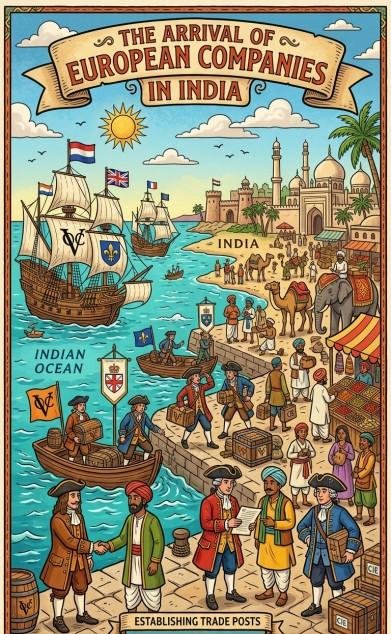
The European companies came to India mainly for trade and commercial profit. India was famous for spices, cotton, silk, indigo variety, saltpetre, and other valuable goods. The Europeans arrived one after another and gradually established political control over parts of India.
ORDER OF ARRIVAL IN INDIA-
→Portuguese
→Dutch
→English
→Danish
→French
→Swedish
1. PORTUGUESE EAST INDIA COMPANY-
→The Portuguese were the first Europeans to arrive in India.
→Vasco da Gama reached Calicut (Kozhikode) on 17 May 1498 through the Cape of Good Hope route.
→He was welcomed by the ruler of Calicut known as the Zamorin.
→The Portuguese established their first trading centre at Calicut.
IMPORTANT POINTS-
→In 1505, Francisco de Almeida became the first Governor of Portuguese India.
→He introduced the Blue Water Policy, which focused on strengthening naval power.
→In 1509, Alfonso de Albuquerque became Governor and is regarded as the real founder of Portuguese Empire in India.
→Albuquerque captured Goa in 1510 from the Sultan of Bijapur.
→Goa later became the headquarters of Portuguese power in India.
CONTRIBUTIONS-
→Introduced tobacco cultivation in India.
→Established the first printing press in Goa in 1556.
→Played an important role in spreading Western culture and architecture.
DECLINE-
→The Portuguese gradually lost power due to corruption, religious intolerance and competition from other European powers.
→They finally left India in 1961 after the liberation of Goa.
2. DUTCH EAST INDIA COMPANY (VOC)-
→The Dutch East India Company was established in 1602.
→The Dutch mainly focused on trade in spices.
→Their first factory in India was established at Masulipatnam in 1605.
→They also established trading centres in Pulicat and Surat.
IMPORTANT FACTS-
→The Dutch defeated the Portuguese in many regions.
→Their main interest was Indonesia rather than India.
→In the Battle of Bedara (1759), the English defeated the Dutch badly.
→After this defeat, Dutch influence in India declined rapidly.
3. BRITISH EAST INDIA COMPANY-
→The British East India Company was established on 31 December 1600 by a royal charter of Queen Elizabeth I.
→The company was also known as the British East India Company (BEIC).
IMPORTANT DEVELOPMENTS-
→Captain Hawkins visited Jahangir's court.
→Sir Thomas Roe came to Jahangir's court in 1615 and obtained trading privileges.
→The first English factory in India was established at Surat in 1613.
→Bombay was given to the British by the Portuguese as dowry during the marriage of Charles II and Catherine of Braganza.
→The British developed important centres at Madras, Bombay and Calcutta.
FORT WILLIAM-
→Fort William was constructed at Calcutta in 1698.
→Calcutta later became the centre of British administration in India.
EXPANSION OF BRITISH POWER-
→In 1717, Mughal Emperor Farrukhsiyar granted trade privileges to the English.
→The British defeated the French in the Carnatic Wars.
→The victory in the Battle of Plassey (1757) and Battle of Buxar (1764) established British supremacy in India.
4. DANISH EAST INDIA COMPANY-
→The Danish East India Company was established in 1616.
→Their main trading centres were at Tranquebar and Serampore.
→Their influence remained limited.
→In 1845, they sold their settlements to the British.
5. FRENCH EAST INDIA COMPANY-
→The French East India Company was established in 1664 during the reign of Louis XIV.
→The founder of French settlements in India was Francois Martin.
→Pondicherry became the headquarters of French settlements.
IMPORTANT FACTS-
→Joseph François Dupleix became Governor in 1742.
→He is regarded as the father of the Subsidiary Alliance concept.
→The French fought the British in the Carnatic Wars.
→Ultimately, the British defeated the French and became the dominant power in India.
6. SWEDISH EAST INDIA COMPANY-
→Established in 1731.
→Could not expand much in India.
→Eventually disappeared from Indian trade.
NOTE-
(i) The main objective of all European companies was trade and profit.
(ii) Gradually their interference in Indian affairs led to the establishment of British rule.
CONCLUSION-
The arrival of European companies completely transformed Indian history. Initially, they came for trade, but gradually they became involved in Indian politics and warfare. Among all European powers, the British succeeded in establishing their rule over India because of their strong naval power, diplomacy and military victories.

we believe in a holistic approach to legal education building not just lawyers, but socially conscious leaders of tomorrow.
